Should you build your website on Wix, with AI, or hire a company? When each option makes sense
An AI template is the best way to start on a small budget. Once a business decides to sell for real, the rules change. This report compares the template, the cheap freelancer and the digital project company, with real projects and published prices.
The short answer: if you are just starting, your budget is small or your project is small, build it yourself with Wix, GoDaddy or an AI website builder. It is fast, cheap and enough to exist online. If your business has decided to sell for real, a digital project company is the better buy. This report shows where the line between the two sits.
When an AI template is the best option
Today anyone can put a page together in an afternoon. You describe your business, the AI suggests copy and colors, and the site goes live. To test an idea or run a short campaign, that is the right call: you spend little while you learn what your customer wants. A template fits if:
- You are testing an idea and do not know yet whether anyone will buy it.
- You sell through Instagram or WhatsApp and only need a place with your phone number, your hours and your location.
- Your budget today does not stretch further, and you would rather put it into product or stock.
Damorus Projects says it plainly because it also teaches it. In its AI coaching, the team works with business owners who want to build their own digital solutions with artificial intelligence: pages, tools and automations. You do not need to know how to code to get started.
The trouble starts when the business grows and the page is still the one from that first afternoon. A page that informs and a page that sells look alike from the outside. Inside, five things set them apart.
1. If Google and AI cannot find you, you do not exist
Templates come out generic: the same design, the same structure and copy that sounds like thousands of other businesses. The platform gives you the tools, not the work. Nobody researches what your customer types into the search bar. Nobody builds a page for each product. Nobody prepares the data that ChatGPT, Gemini or Perplexity read.
The result is harsh: if someone does not have your direct link, it is as if you did not exist. Neither Google nor AI assistants recommend you. And a generic site does not look serious or professional either, right when the customer is deciding whether to trust you.
A project built to compete comes with SEO (what Google needs to show you) and GEO (what an AI needs to quote you): pages written in the words people actually use, structured data and an llms.txt file that sums up the business for machines. The guide on how to get AI to recommend your website explains it step by step. The rules change every few months, so the team keeps up with what is new. The goal: when someone asks about a business like yours, the AI names yours.
2. A cheap landing page informs; a sales funnel sells
A template comes with basic conversion psychology and basic usability. It looks fine, but there is no science or engineering behind each click. A cheap landing page says what you sell and leaves a button. A good sales funnel walks the customer from the first doubt to the purchase, step by step, and that has to be designed.
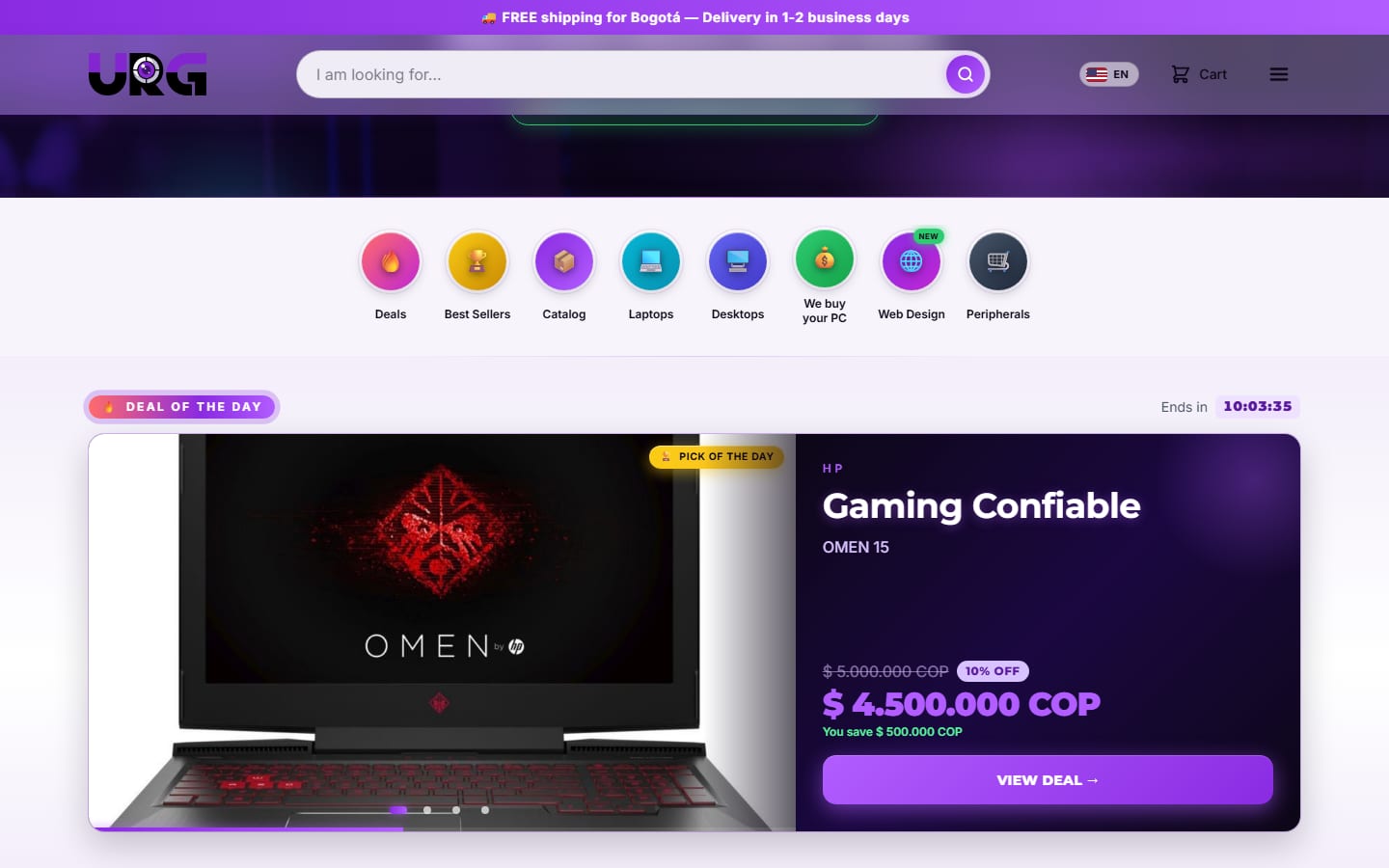
A real example. In the URG Technology store, the deal of the day has a countdown that resets every morning. Discounts show as a percentage, because it reads faster. The deal button goes to the product page first, not straight to checkout: people who see the photos, specs and warranty buy with the right expectations and return less. When a one-of-a-kind computer sells, the button switches to "Notify me when it is back" and the store offers others with similar power. None of those decisions comes with a template.
That is UX and conversion: every screen designed to support a decision, with no cheap tricks and no fake urgency.
3. Without analytics, you decide blind
A page built in a rush usually ships without tracking, or with a general counter nobody checks. So you do not know who visits, how often they come back or where they come from. Every dollar spent on ads turns into a bet.
The La Roca catalog has its own private dashboard. It shows where visits come from (Google, Instagram, WhatsApp, Google Maps or a business card with a QR code) and which buttons people tap. With that, the business knows which channel brings interested buyers and where it pays to invest. At Damorus Projects, that visits dashboard can be added to any plan.
4. When something breaks, who answers?
With a template, you fix the errors yourself, with the platform's general support. With a cheap freelancer the risk is different: they disappear once they are paid and nobody else knows that code.
Damorus Projects publishes its prices and gives a two-year warranty that it works: if something it delivered does not work as agreed, it fixes it for free. Scope and price are put in writing before work starts. And before you pay, you see a free mockup of your project.
Security grows with the size of the system. Every project ships with Cloudflare, protection against DDoS attacks and SQL injection, and protected passwords. The Atlantic Center software keeps its data in three backup layers: the cloud, each computer and a daily copy off site. On top of that, it has no permission to delete data. Projects that handle sensitive data add specialized protection on the Diamond plan.
5. Before building, the market gets studied
A template starts with the design. A project starts with the business: market research, an analysis of competitors and of the current brand, with its strengths and weaknesses, and a comparison with the big brands around the world that sell the same thing. That is how you get products built to compete with them, not to look like the shop next door.
Before designing La Roca, the team studied how landscaping, garden center, remodeling and product brands that sell well online organize their catalogs, especially how they put the price up front. The colors and typefaces came from the business logo, which is a mountain.
The project grows with you too. A launch site is not the same as the site of an established brand. Each plan upgrades to the next one without starting over, Gold and Diamond include months of updates, and the infrastructure is set up to carry more users and more sales.
Web apps: the website and the software, connected
This is the biggest difference, the one no template reaches. A web app is a website and a piece of software working in harmony: what happens in one shows up on its own in the other.
Look at the Atlantic Center software, built for a swimming school in Bogotá. It replaced a program from 1996 and today handles about 390 students. It runs on two or more synced computers and keeps working without internet: it queues the changes and uploads them when the connection is back. It updates itself remotely. Every change is logged with who made it and when.
Now picture that software connected to a website. The customer books or pays from their phone, and the change shows up on its own on the owner's computer, with nobody copying data by hand.
The URG Technology store is built on that logic:
- It takes payment the way the customer prefers: card, Nequi, Mercado Pago or Bre-B. Details in how to take payments in an online store in Colombia.
- It holds the computer while the customer pays, so it never sells twice. Here is how.
- It sends the shipping emails on its own, from approved payment to dispatch.
- It buys used computers to source inventory, with a section of its own for it.
- The owner runs everything from a private dashboard with two-factor login and 31 business metrics.
Between them, these two cases bring together almost everything the team knows how to do today, with that level of detail. You can read both in full: Atlantic Center and URG Technology.
Even the most basic plan is more than a landing page
The Silver plan, from $1.000.000 COP$500 USD€500 EUR, is not a single-screen page. It is a multi-page website with SEO, a sales funnel, Google Maps optimization and conversion psychology. It includes basic market research and a brand and growth guide.
La Roca is the proof. It is a natural stone catalog in Girardot, Colombia, built in 4 to 5 days. Each stone has its own page with a photo, a price and the nicknames people use to search for it. A calculator works out the material and the cost from the square meters of the wall, and the cart turns the order into a WhatsApp message. Girardot, Ricaurte and Flandes each have their own page for Google. Today customers from other cities write in, even from Santa Marta, without the business paying for ads.
Gold, from $4.000.000 COP$1,500 USD€1,500 EUR, adds an admin dashboard, a store with a payment gateway or cloud software. Diamond, from $8.000.000 COP$5,000 USD€5,000 EUR, is the level with no ceiling. Every plan includes the first year of hosting and domain. The details are on pricing and in the guide How much does a website cost?.
When each option makes sense
| Option | It fits if | It falls short when |
|---|---|---|
| AI template (Wix, GoDaddy or an AI website builder) | It fits ifYou are testing an idea, your budget is small or you only need a place with your contact details. | It falls short whenYou want to show up on Google and in AI answers, measure your visits or sell with rules of your own. You fix the errors yourself. |
| Cheap freelancer | It fits ifYou already have copy and photos, need a few sections and know someone you trust. | It falls short whenYou need payments, stock or a dashboard. The project depends on one person. |
| Digital project company | It fits ifYou want to sell for real: strategy, SEO and GEO, conversion, analytics, a warranty and room to grow. | It falls short whenYou do not know yet whether your idea sells. Then start with a template, or learn to build it yourself. |
Frequently asked questions
Is it better to build my website on Wix or to hire a company?
It depends on what you need it for. If you are starting out or testing an idea on a small budget, Wix, GoDaddy or an AI website builder are enough. If you want Google and AI assistants to recommend you, every visit to move toward a purchase and to know where your customers come from, a digital project company like Damorus Projects is the better buy.
Can a website made with AI rank on Google?
It can show up, but it rarely competes. To appear on Google and in answers from ChatGPT, Gemini or Perplexity you need SEO and GEO: pages written in the words your customer uses, one per product or service, structured data and an llms.txt file. The template does not do that work on its own.
What does a website built by a company have that a template does not?
Market and competitor research before the design, SEO and GEO, a sales funnel built on conversion psychology, analytics to know who visits you, security sized to the system and someone who answers when something breaks. At Damorus Projects all of that comes with a two-year warranty that it works.
How much does it cost to hire Damorus Projects?
Prices are published: Silver from $1.000.000 COP$500 USD€500 EUR, Gold from $4.000.000 COP$1,500 USD€1,500 EUR and Diamond from $8.000.000 COP$5,000 USD€5,000 EUR. You pay once, the first year of hosting and domain is included, and before you pay you see a free mockup.
What is a web app?
A website and a piece of software connected, so that what happens in one shows up on its own in the other. For example, the customer books or pays on the website and the change reaches the business software by itself. The URG Technology store takes card, Nequi, Mercado Pago or Bre-B, holds the product while the customer pays and sends the shipping emails on its own.
What happens if I want to grow later?
Each plan upgrades to the next one and what was built is kept, so there is no starting over. Gold includes three months of updates and Diamond six. The infrastructure is set up to carry more users and more sales.
What happens if something breaks after delivery?
Damorus Projects gives a two-year warranty: if something it delivered does not work as agreed, it fixes it for free. New changes are quoted as updates.
Can I learn to build my own website with AI?
Yes. The Damorus Projects AI coaching teaches you, in one-on-one video sessions, to build your own digital solutions with artificial intelligence: pages, tools and automations. You do not need to know how to code to get started.
The decision
If you are starting out, start cheap and learn. If you have decided to go out and sell, build a winning project. Damorus Projects builds projects made to sell: researched before they are designed, ready for Google and AI, measured from day one and backed by a two-year warranty.
Know someone this helps? Share it.