URG Technology Project
For URG Technology, a Bogotá company with more than 20 years in computer repair, we built a 24/7 online store that sells for them. Customers find their computer in seconds, understand every component without technical knowledge and pay however they like: card, Nequi, Mercado Pago or Bre-B. Logistics emails go out on their own, and the store also buys used computers to refresh its inventory. The owner runs everything, from payments to shipping, from a private dashboard.

Client
URG Technology SAS · Bogotá, Colombia
Disciplines
Online store · Online payments · Admin dashboard · Google and AI
Type
Pro e-commerce · online store with payments and a custom dashboard
Public storefront
Our first big project was a complete store.
URG sells laptops and desktops for gamers, creators, businesses, and home use, both new and refurbished units that look like new, with a warranty and a fair price. The idea was to sell online and through social media, something almost no store in Unilago does yet, and that required a store that could take payments online and that the owner could run without knowing how to code.
It was the first big project we ever took on, and we treated it as a test, to see how far we could go. We learned almost everything as we went, and the store came together piece by piece over several months.
Over those months we confirmed that AI, well directed, can build almost anything you set out to build, and that is where the idea for Damorus Projects came from.
Letting the customer buy without messaging anyone.
We wanted an online store with payments where someone could complete the entire purchase on their own from a phone: find the machine, understand what it is good for even without knowing specs, pay however they prefer, and get it delivered home.
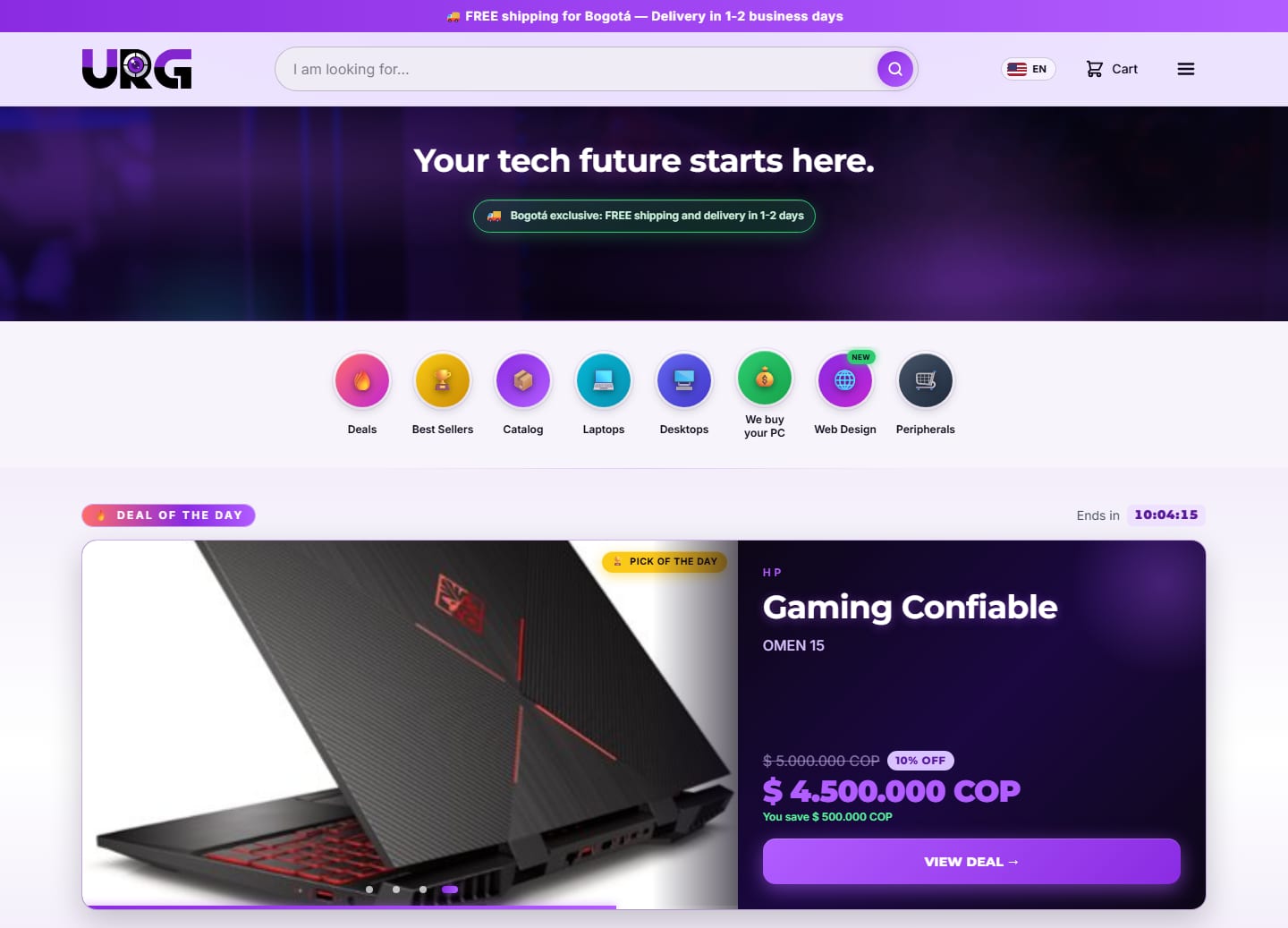
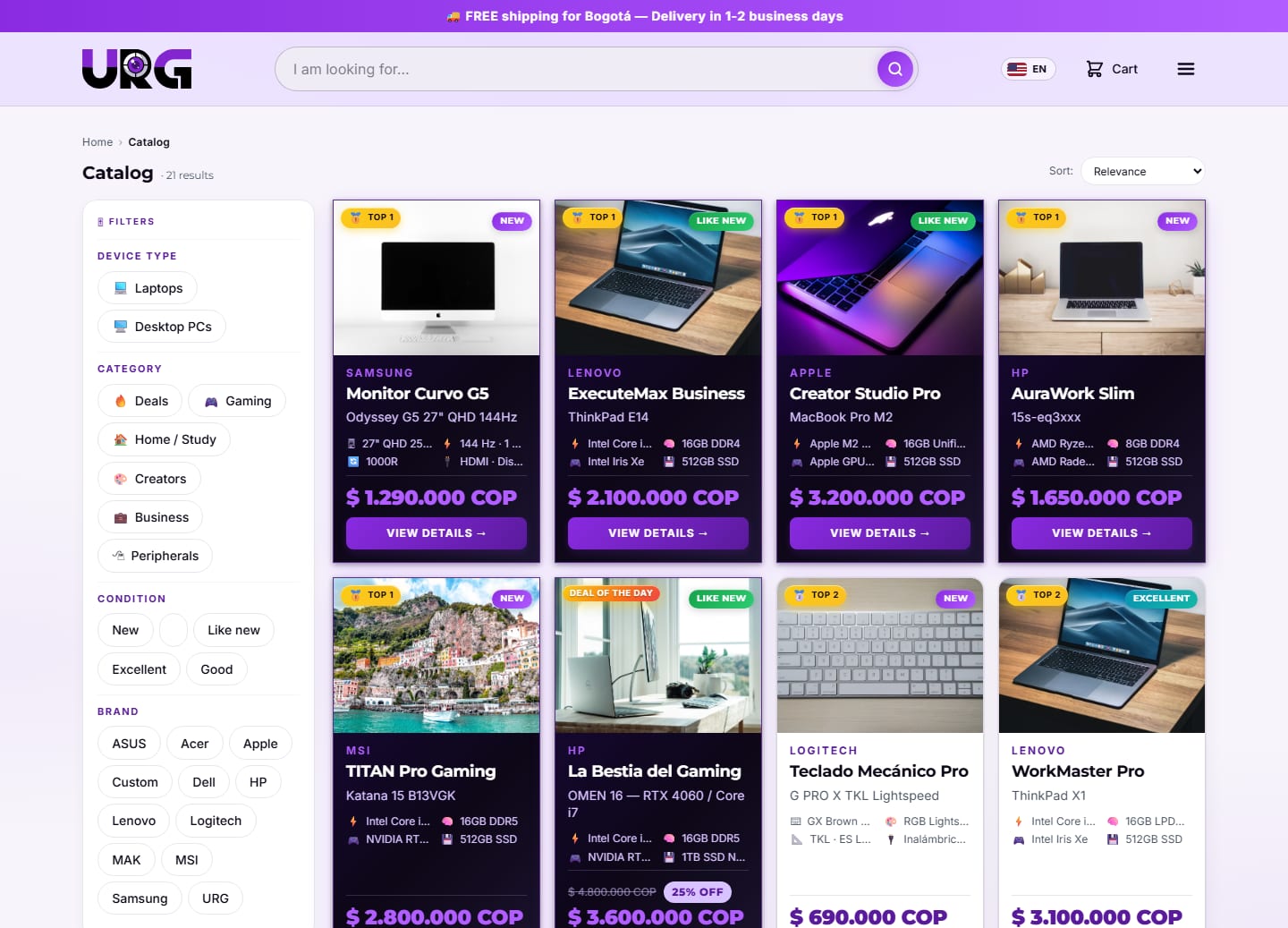
The homepage has a day's deal with a countdown and best sellers split by use case (gaming, school, creators, and business). The search bar suggests machines as you type, and every computer has its own page with specs explained in plain words.
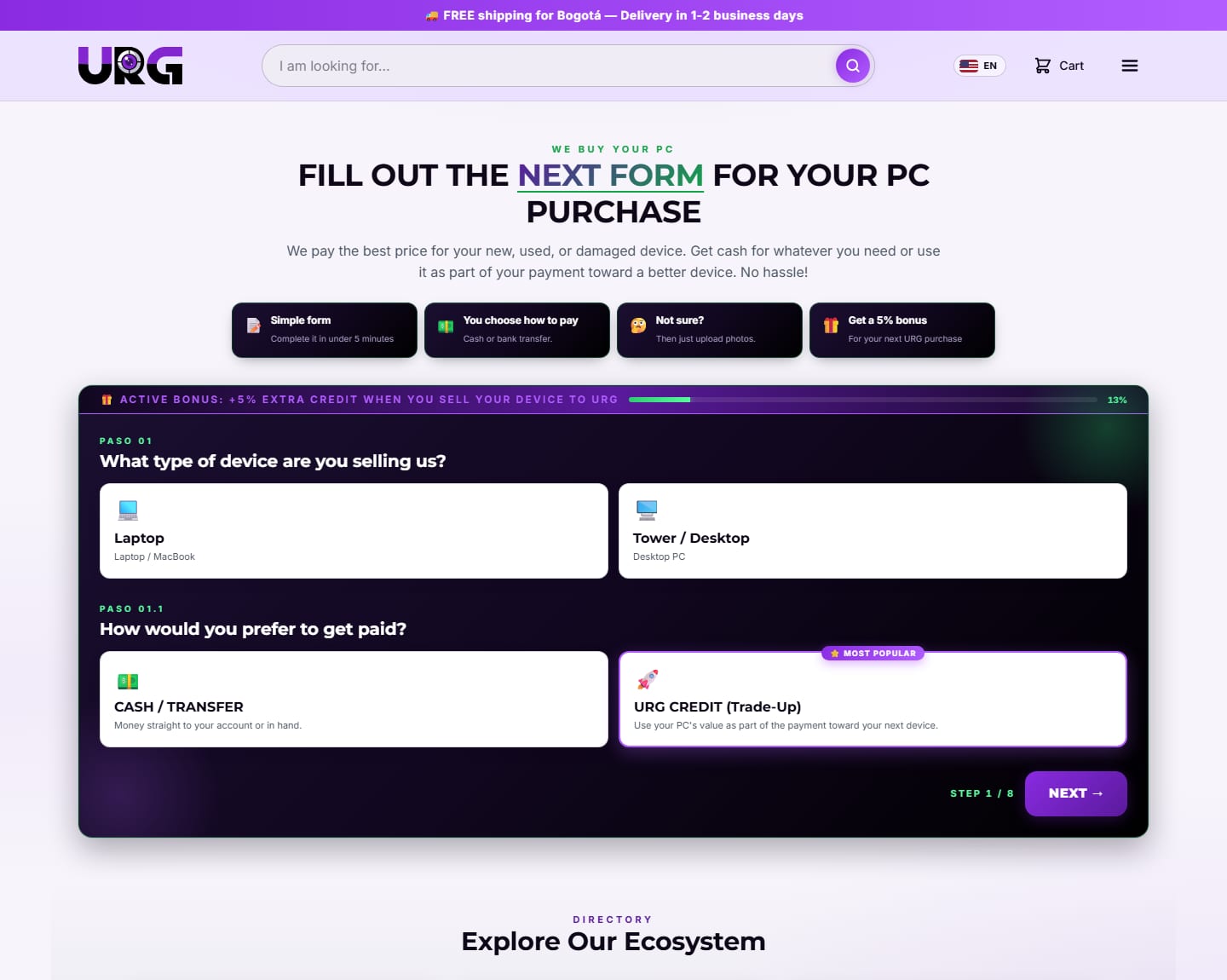
There is also "We Buy Your PC," a step-by-step form where someone describes the computer they have, uploads photos, and receives an offer to sell it or trade it in toward another one. The idea comes from the company's repair shop, which needed a steady source of machines to refurbish.
Anyone selling their computer can get paid in cash or by transfer, or apply it as credit toward their next machine.
Does your business need something like this?
I want my free mockup →A one-of-a-kind machine cannot be sold twice.
Before building, we looked at how Amazon and Mercado Libre organize their catalog and how many steps they put into checkout. We borrowed that logic; the visual identity and tone are URG's own.
Paying had to be as easy as choosing: before paying, the customer sees an order summary with shipping and VAT broken out.
The trickiest part was inventory. In a store selling refurbished machines, almost every unit is one of a kind, and if two people pay for it at the same time, one of them ends up waiting for a refund. To avoid that, the store uses inventory control: it holds the machine server-side, on a first-come basis, and if someone else got there first, it says so clearly and shows similar machines instead.
Ready to sell, waiting to launch.
The store loads fast on mobile and carries the customer from browsing to checkout in a few steps. Every product carries structured data that Google and AI assistants read when someone searches for computers in Bogotá.
Behind it sits the private dashboard, which makes up most of the project. That is where products get uploaded, payments get confirmed, shipments get tracked, and customer searches get reviewed, all without touching code.
The store has not launched yet. Beyond the code, a store needs professional photos of every machine, marketing, advertising, and active social media, and the budget for that is not there yet. In the meantime, the public storefront is open to browse.
Every way to pay, in one place.
If a customer cannot find their payment method, they can easily leave without buying. URG takes Visa, Mastercard, and American Express cards, plus the wallets and instant bank transfers people use every day in Colombia. For a store selling in the United States or Europe, the list changes and the work is the same: Apple Pay and Google Pay to pay in one tap from the phone, PayPal for anyone who would rather not type a card number, and Klarna to split the price into four payments.
What decides the sale is what happens after that button. A card payment confirms itself at the server: the customer sees "payment approved" and the machine is held in their name. A transfer arrives with a receipt, and the machine stays reserved while an administrator validates it from the dashboard. Nothing ships before the money is confirmed, and adding another method later is a change at checkout, not a new store.






What the owner sees when logging into the dashboard.
On login, the day's sales, stock, shipments in progress, and profits all appear, and the numbers update in real time. A bell icon flags anything pending, like transfer payments still waiting to be confirmed.
From there, product pages get created, banners and prices get updated, and dozens of business metrics can be reviewed, part of the store's custom analytics. The server handles the repetitive work, like confirming card payments and releasing expired reservations, even when nobody has the dashboard open.
Sales today
$2.4M
Stock
Locked
Shipping
8 in transit
It started as a repair shop.
Behind URG is a Bogotá company with more than 20 years of experience repairing computers of every brand. It was called INCOLSERVICE, and much of its craft was taking in machines that others had given up on and getting them running again.
The change started with INCOLSERVICE 2.0, a business model proposal that laid out a four-page site and already split customers into gaming, home, creators, and business. Those categories carried almost untouched into the final store, along with the name URG and its new visual identity. The repair shop is still running, now with an online store alongside it.
“AI can build anything, but directing it is like directing a person.”
+ See the technical detail
Project details
- Client
- URG Technology SAS (formerly INCOLSERVICE)
- City
- Bogota, Colombia
- Sector
- Refurbished and new computers, computer repair
- Year
- 2026
- Duration
- ~4 months
- Documentation
- V1.1 (Apr 27, 2026, ~195 pages), V2.0 (Jun 19, 2026, 98 pages)
- Iterations
- 293 tasks, from v1.0 to v24.18.26
- Stack
- React 19, Vite 6, Supabase, Mercado Pago, Bre-B, Resend
- Dashboard
- 4 blocks, 31 metrics, 13 server functions
- Status
- Built to 95%, awaiting launch
How it is built
It is a single-page application (SPA) built with React 19, Vite 6, Tailwind CSS v4, and Framer Motion. Navigation happens without reloads, and every product and section has its own web address to share and rank. The front end is served as static files, while payment, stock, and email logic run on the server.
Payments and stock reservation
Cards are charged through Checkout Pro and confirmed server-side with Edge Functions. Payment notices arrive through webhooks; instant transfers come with a receipt to validate in the dashboard. No card data is stored. An atomic stock reservation stops two people from buying the same one-of-a-kind machine.
The backend
It runs on Supabase: PostgreSQL with Row-Level Security, Edge Functions in Deno, Realtime to refresh the dashboard without reloading, and a cron job that releases expired reservations. The store's emails go out through Resend with a verified domain. None of this depends on someone leaving a tab open.
A custom admin dashboard
Access requires two-factor authentication (TOTP), bot verification, a brute-force delay, and decoy routes, and it carries a noindex tag so Google never shows it. From there, the owner creates product pages, confirms payments, tracks shipments, reviews metrics like sales, conversion, and average order value, exports reports in PDF and CSV, and updates payment keys, banners, and prices.
Google, AI, and automatic deployment
Every product carries structured data (JSON-LD Schema.org/Product) and every page has its own meta tags, with a sitemap and an organized semantic hierarchy. Changes go live with a single push, which builds and publishes the store within a couple of minutes. In total, more than 290 improvements were logged.
The internal manual
Everything is documented in a manual of nearly 200 pages, covering decisions, business rules, edge cases, and tests. It makes it possible to maintain and extend the store without breaking what already works. The version with sensitive data removed is linked at the top of this page, under the project's documents.
Have products to sell online?
We build you the store with payments and a dashboard to run it. From day one, we tell you what else it needs to launch. Choose below how to get started.
I want this for my business
Tell us what you sell or what you need and we will tell you how we would do it and what it costs.
I want my free mockup →Want to invest in URG?
An idea with a massive market: being the first store in Unilago to actually take the internet seriously. We are looking for partners in marketing, content, and sales.
I want to invest →Also by email at Alejandro@damorus.com.
What we used here
- E-commerce
- Payment gateways and bank integration
- Inventory control and stock holds
- Email automation
- Admin dashboards and command centers
- Dashboard security
- Custom analytics, no Google Analytics
- Technical and content SEO
Want to know how it was built?The full story of the project, piece by piece: 25 chapters, about 35 minutes.Tap to read it here ↓
The full story
How a Bogotá computer repair company built its online store, with payments, stock reservations, and a private dashboard
01OriginThe repair shop by Unilago
Before URG Technology, there was a repair shop. For more than twenty years, a Bogotá company called INCOLSERVICE repaired computers of every brand out of a storefront across from Unilago. Part of its craft rarely got noticed: taking in machines other people had written off as a total loss and, with diagnostics and the right parts, getting them running again.
Over time the company restructured. It changed its name, its logo, and its visual identity, and became URG Technology, but it kept what had sustained it all along: repair service for every brand and refurbishing used machines. The change raised a question the shop had never fully thought through: what would happen if that expertise stopped depending on a customer walking through the door.
The answer came from the founder of Damorus Projects, an environmental engineer: sell refurbished, secondhand computers online. A well-refurbished machine performs like one that costs much more, but a physical storefront only reaches whoever walks down that aisle, while a store online could reach anyone in Bogotá or across the rest of the country. The hard part was getting someone to buy a used computer, sight unseen, from a company they had never heard of. Much of what follows is how we worked on that distrust.
Someone had to be willing to buy a used computer, sight unseen, from a company they had never heard of.
Source: Interview with the Damorus Projects team, 2026: the history of INCOLSERVICE and its restructuring into URG · URG V2.0 (Jun 19, 2026), §5.1.2 Shipping information: location across from Unilago
02MethodThe INCOLSERVICE 2.0 proposal
Before writing a single line of code, the founder wrote a short proposal called INCOLSERVICE 2.0, closer to a Business Model Canvas than to a design file. It laid out a four-page site (home, buy a PC, sell your PC, and repair service) and already sorted the offer by customer type: gaming, home, creators, and business. The company had no fixed catalog, so every category led to a chat with an AI assistant that opened with a ready-made message, something like "I want to buy a gaming computer, what do you have?", and a green button invited people to talk to an advisor on WhatsApp.
Where the document got the most right was trust. It proposed saying outright that refurbished machines were "as powerful as a new one, but up to 50% cheaper," backed by the company's own quality seal. It called for a real map of the storefront and a line that sounds minor, "we're on the second floor," because someone afraid of getting scammed wants to know exactly which staircase to climb. And it demanded the site look right on a phone first, with thumb-sized buttons and WhatsApp on the right, where the thumb lands without effort.
Much of that proposal made it into URG. The four categories survived almost untouched in the final store, along with the phone-first obsession, WhatsApp always within reach, and the three questions the document asked of every change: does it build excitement, does it build trust, does it build sales. Today that is the first thing we do on every project, a quick discovery pass on the business (who buys, what they fear, what convinces them) before we design anything. We apply the same approach in our services.
The proposal called for writing "we're on the second floor," because someone afraid of getting scammed wants to know exactly where they're headed.
Source: INCOLSERVICE 2.0 proposal (internal document, 2026): categories, WhatsApp advisor, chatbot, map, "second floor," and mobile-first approach · URG V2.0 (Jun 19, 2026), §2.5 Best Sellers: the four core categories of the final store
03AmbitionAlmost 200 pages
The project kicked off between January and February 2026, and for about two months almost everything was writing. The founder drafted a guide document that ended up called URG Technology Digital Store, version 1.1, dated April 27, 2026, running about 195 pages. He thought of it as the complete instruction set for what to build, so an AI or an outside team could stand up the store without guessing anything.
It opened with identity and pricing logic (the brand purple, the struck-through price, the discount percentage) and moved through the home page block by block, every tab, the three product cards, the checkout form, and the system for naming orders. Then it described the admin dashboard across four blocks. At the end came twenty-five error-prevention rules, answering what happens if the connection drops, if an ad blocker stops the payment gateway, if two people pay at the same time, or if someone tries to guess the dashboard's address.
In a store, the expensive mistakes live in the logic: a miscalculated VAT, a machine sold twice, an email that never goes out. Writing them down first forces you to think them through while fixing them is still cheap. The document also worked as memory: whenever something broke, the team went back to it to see what had been promised and what had changed. Writing before building is now the foundation of how we work at Damorus Projects.
A miscalculated VAT or a machine sold twice is cheaper to fix in a document than in the live store.
Source: URG V1.1 (Apr 27, 2026), table of contents and §7 Dashboard logic and error prevention (7.1 to 7.25) · Interview with the Damorus Projects team, 2026: two months of writing before building
04ToolsAntigravity, Figma, and Claude
With the document ready, the next question was what to build it with. The first thing the founder tried was Google Antigravity, a coding environment with AI agents, and it did not work out for URG. Next he tried Figma, the interface design tool many professional teams use (V1.1 even describes screens meant for Figma). What came out looked good, but the cost did not add up for a project running on his own money, with no team behind it.
Then came Claude, Anthropic's AI assistant. The founder puts it this way: "By the first night, I knew it was the right tool." Claude could take in a massive document, understand the business rules, and turn them into working code, then come back to that code later when something broke. From there, the bottleneck shifted to directing it: explaining clearly, reviewing, and deciding.
For about four months the founder worked alone, many nights without sleep, the document on one side and the AI on the other. There was no development team, no designer, nobody dedicated to testing. Every task got requested, tested, and logged, and if the result did not hold up, it got requested again with more precision.
"By the first night, I knew it was the right tool," the founder says about Claude.
Source: Interview with the Damorus Projects team, 2026: trying Google Antigravity, Figma, and Claude · URG V1.1 (Apr 27, 2026), §3.10 and §6.11 E: references to the Figma designs
05TourThe home page
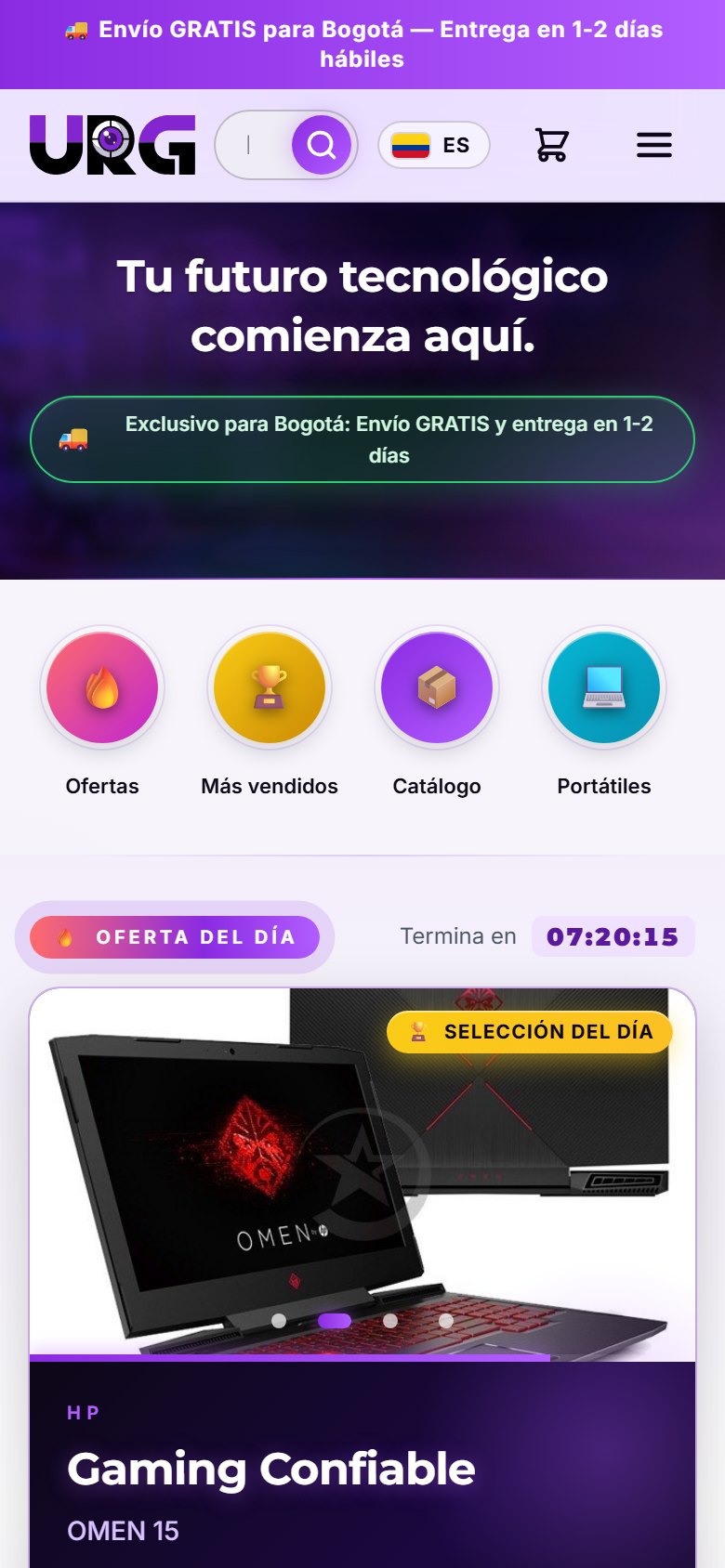
The top of the home page carries a compact hero, on purpose: one line, "Your tech future starts here," and a green pill for free shipping in Bogotá with delivery in one to two days. The document wanted the customer to feel like they were walking into a premium terminal, and a giant deals headline worked against that. On mobile, the choice also freed up space: the header shrank from 120 to 96 pixels, and the search bar moved to a slim second row.
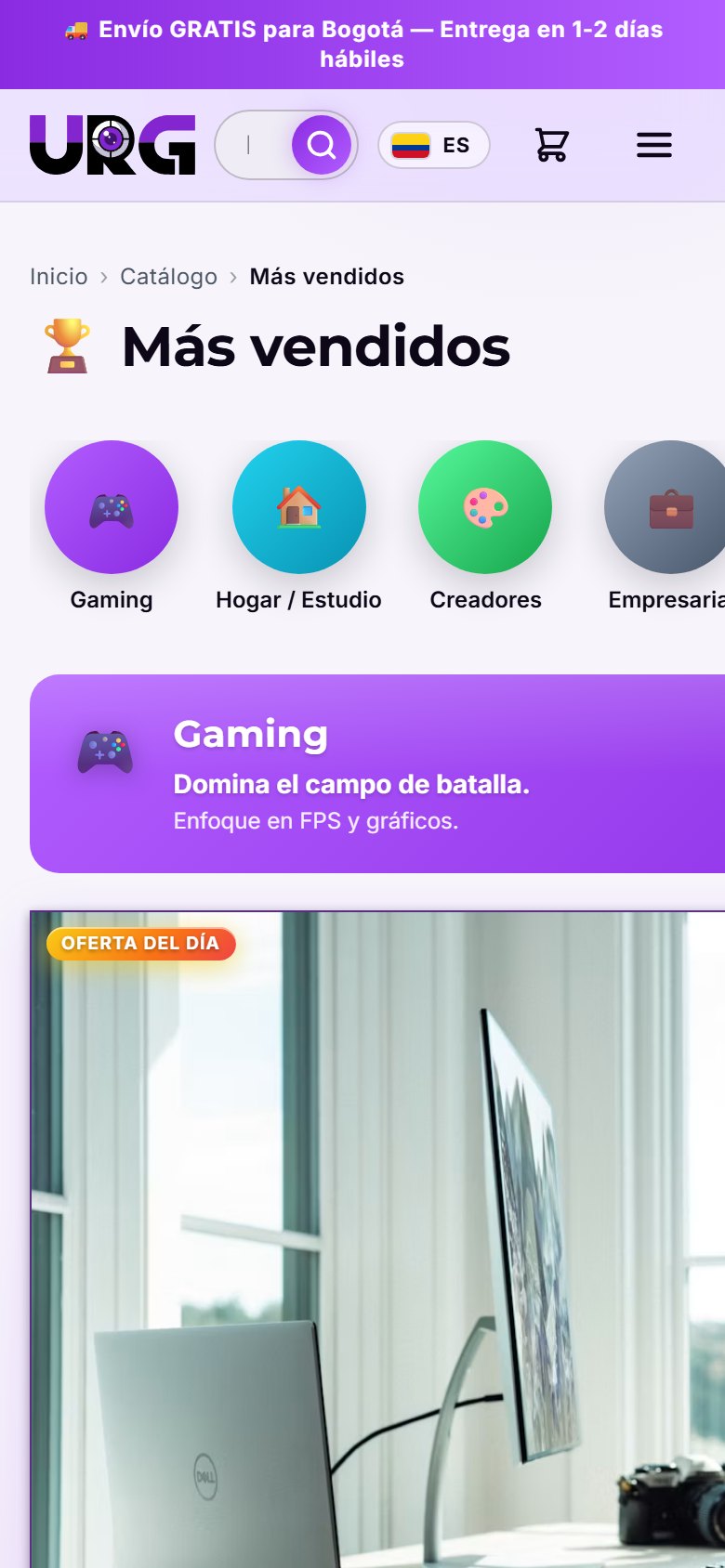
Below that sit the bubbles, circles you swipe through with a thumb that lead to deals, the catalog, laptops, desktops, "We Buy Your PC," and peripherals; that last one hides itself until the first peripheral actually goes on sale. Next comes the day's deal, a dark card set against the store's white background, with photos that change every four seconds and a countdown that resets at 8:00 a.m. Colombia time. On mobile, the card shows a sliver of the next block so it is clear the page keeps going.
After that come the best sellers, one champion for each type of use (gaming, home and study, creators, and business), and the entire card is clickable, because aiming for a small button is unnecessary effort. Then follow the "We Buy Your PC" block and the grid of our store, with chips that filter instantly. At the bottom, the footer gathers what builds trust: hours, a map, payment methods, and the logos of DIAN (Colombia's tax authority) and the Bogotá Chamber of Commerce. Every block gets turned on, turned off, or reordered from the dashboard, with no code involved.
Every block on the home page gets turned on, turned off, or reordered from the dashboard, with no code involved.
Source: URG V2.0 (Jun 19, 2026), §2.1 to §2.11: header, hero, bubbles, day's deal, best sellers, our store, and footer · URG V2.0, §6.2.3 C: Dynamic Storefront Module
Want something like this for your business?
I want my free mockup →06TourPodiums and SOLD stamps
URG's references were Amazon and Mercado Libre, and on top of that the founder, who is a gamer, built his own layer of game mechanics. Every category has a three-spot podium with gold, silver, and bronze borders, and the best-sellers page shows all twelve spots at once. If a category has fewer than three machines, the empty spot reads "position open" instead of disappearing. The catalog reads like a leaderboard.
A sold machine stays visible. A red veil drops over its photo with a centered SOLD stamp and the message "Mission accomplished," and the buy button changes to "Notify me when it's back," which saves the interested buyer's email and writes to them if the product gets listed again. The stamp used to sit at an angle and moved to centered in one of the later versions. In a store selling refurbished machines, many units really are one of a kind, so the scarcity the store shows is real.
The podium reorders itself with a rule called the domino effect: if the number one spot sells out, the second-place machine moves up to first, the third moves to second, and the whole row rearranges on its own, with nobody editing anything. The day's deal can rotate like a carousel or run in exclusive mode, with a single deal per day that resets at eight in the morning. And if the machine on deal is also the champion of its category, it carries a flame badge instead of a medal on the best-sellers page, so the customer never sees the same product twice with no context.
When a machine sells, its photo gets a SOLD stamp and a button to notify anyone interested if it comes back.
Source: URG V2.0 (Jun 19, 2026), §2.4 Day's Deal (SOLD status and Notify Me), §2.5 Best Sellers, and §3.13 the best-sellers page · URG V2.0, §6.3 Block 8 (domino effect) and §6.4.1 C (day's deal modes) · Interview with the Damorus Projects team, 2026: inspiration from Amazon, Mercado Libre, and his own game mechanics
07TourThe search bar
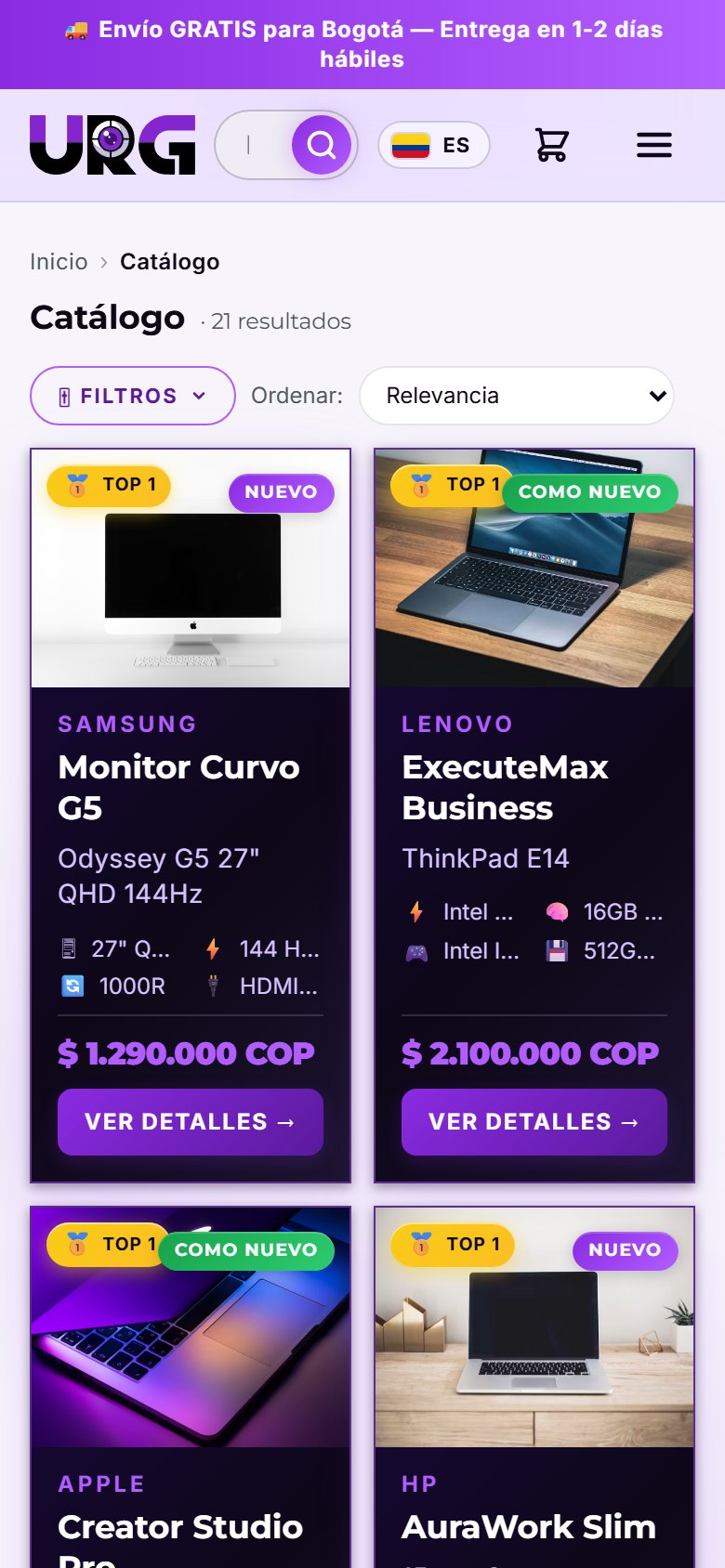
People do not search with the exact spec sheet in mind. They type "Lenovoo," "rendering," or "macbook 2010." That is why URG's search checks three layers in order: first the product name and brand, which carry the most weight; then the technical specs, like processor, memory, graphics card, and storage; and finally a set of invisible tags the admin assigns to each machine. A laptop tagged "architecture" or "CAD" shows up when someone searches "rendering," even if that word never appears in its name.
It also forgives mistakes. It ignores accents and capitalization and tolerates up to two wrong letters in a word, so "Lenovoo" still finds Lenovo. From the third letter onward it shows up to five suggestions (a brand, a specific machine, or a whole category), remembers each person's last three searches, and surfaces the week's trends across the whole store. There has been a rule since the first document: zero results is not allowed. If someone searches for a machine the store does not have, it offers three alternatives in the same price range or category, plus a button to talk to an advisor.
In the full catalog, the customer first picks what it is (laptop, desktop, or peripheral), and only then do the use-case chips appear, which can be combined. Brand filters build themselves from inventory: the moment the first MSI comes in, its filter appears, and when the last Apple sells, it disappears. When a customer opens a machine and taps back, the catalog leaves them at the same scroll position with the same filters set, so they never have to start over.
If someone searches for a machine the store does not have, it shows three alternatives and a button to talk to an advisor.
Source: URG V2.0 (Jun 19, 2026), §3.1.1 to §3.1.7: three-layer indexing, Levenshtein distance ≤ 2, autocomplete, zero results, filters, and scroll-position memory · URG V1.1 (Apr 27, 2026), §3.11 D and §4.2 X: typo correction and automatic brand filters
08TourThe three product cards
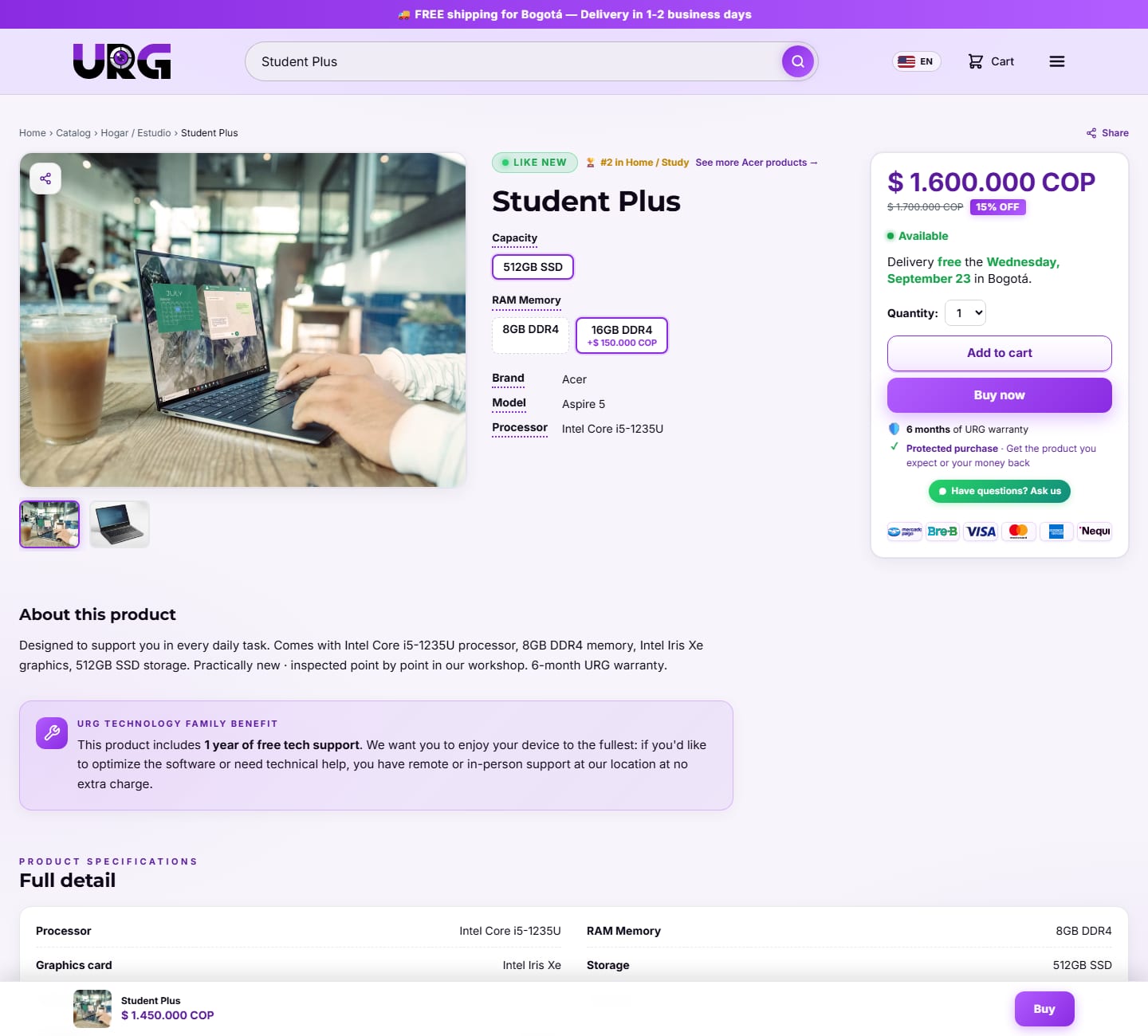
The same computer shows up three different ways depending on where the customer is. All three come from the same component, so changing a brand or a spec updates all of them at once. Card 1 is clean and vertical, built for a quick glance on the home page: photo, product name, brand and model, the struck-through price, the final price, and the discount percentage. Card 2 lives in the catalog and adds a short list of labeled specs (memory, graphics, storage, and warranty), because by then the customer is already comparing options.
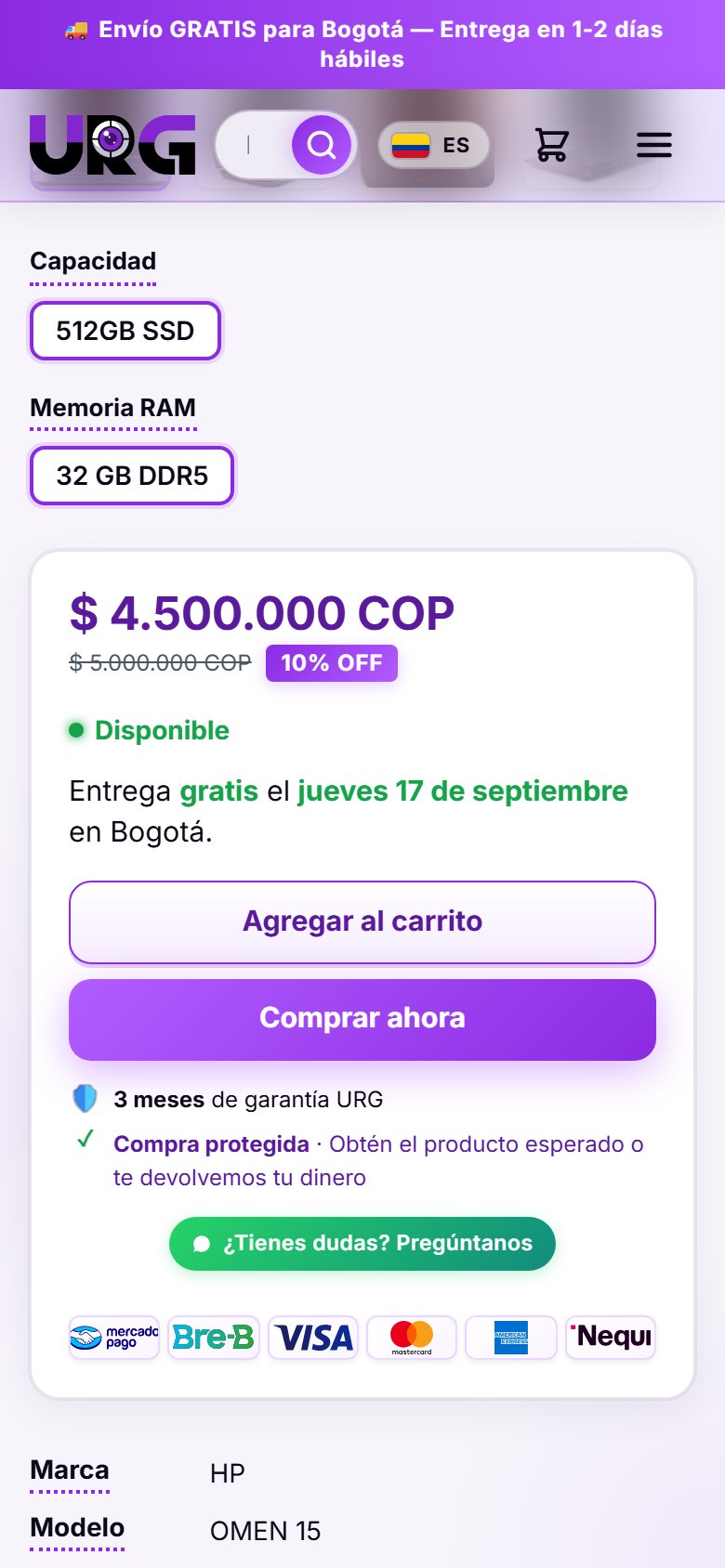
Card 3 is the full product page, where the purchase actually gets decided. On desktop it runs in three columns (photos, the machine's identity, and checkout), and on mobile it collapses into one, following the order in which questions actually come up for a buyer. Every spec carries a help icon, the SpecTooltip, that explains in plain words what it means, for instance that more cores help with heavy multitasking. On mobile it opens with a tap. Next to the buy button sits a delivery promise that calculates itself: two business days, skipping Sundays, with the date spelled out.
The share button uses the phone's own share menu or copies the link with a confirmation message, and pasting it into WhatsApp pulls in the photo, the name, and the price. On desktop, a magnifying tool zooms the photo up to five times to check hinges and ports. On mobile, once the buy buttons scroll off screen, a sticky bar appears at the bottom with the name, the price, and a single button. At first it showed all the time and got in the way, so now it only appears from the description onward, and the WhatsApp button has its own reserved space so the two never collide.
All three cards come from the same component, so a spec gets changed once and stays changed everywhere.
Source: URG V2.0 (Jun 19, 2026), §4.1 to §4.3: Card 1, Card 2, and Card 3 (SpecTooltip, delivery promise, sharing, zoom, and the sticky mobile bar)
09TourWe Buy Your PC
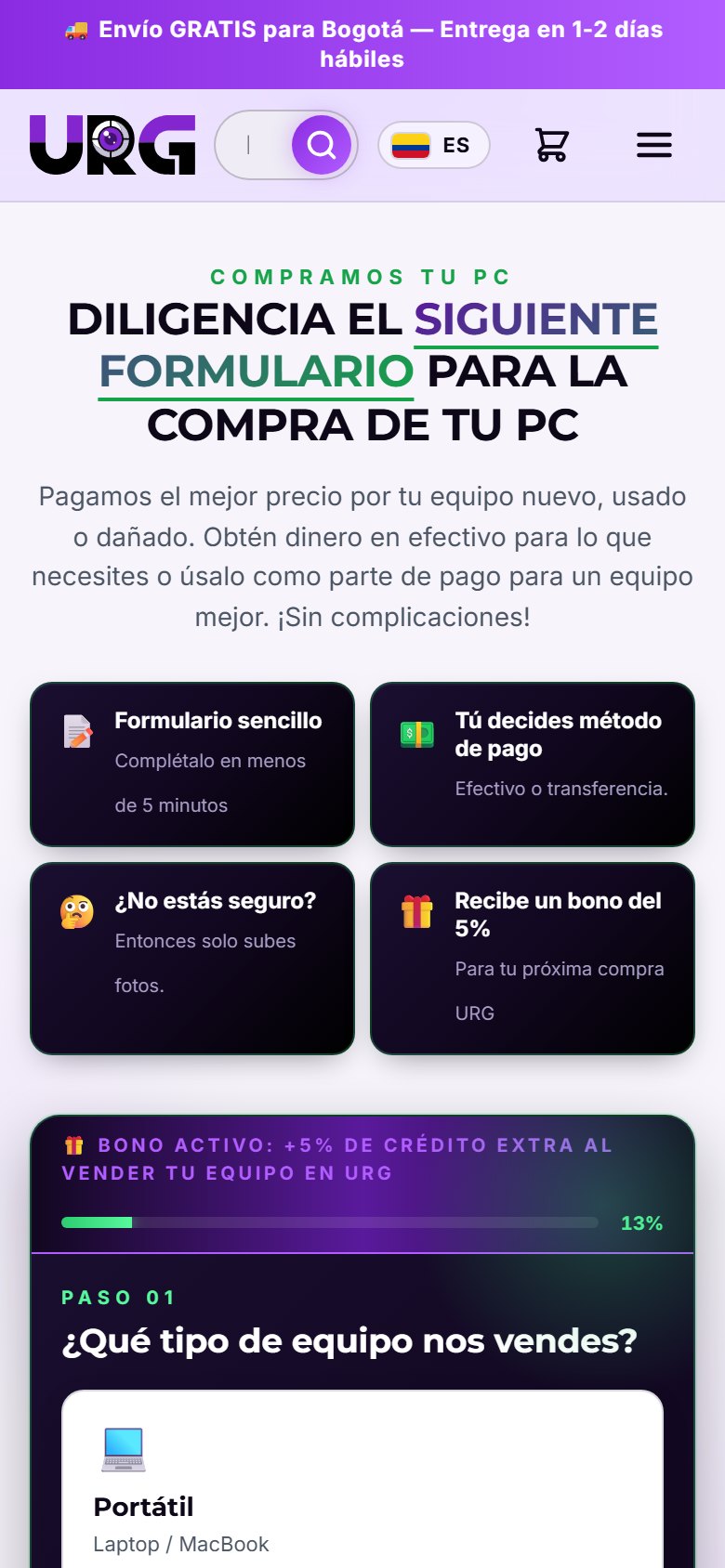
"We Buy Your PC" comes from the repair shop's original craft, which needed a steady supply of machines to refurbish. On the store it is a nine-step form that feels like a game. First you choose between a laptop and a tower (choose tower, and the questions about the screen, battery, and charger disappear on their own), then how you'd rather get paid: cash, a transfer, or URG credit toward your next machine. After that come the unit's condition, brand and model, processor and memory, the drive, its exterior condition graded A through D, the reason for selling, and contact details.
The questions are written for people who do not know computers. The drive question is a rocket ("it flies, I've got a solid-state drive") or a turtle ("it's kind of slow"), and processors carry personality labels like "perfectly balanced" or "beast mode." For anyone who still does not want to answer, there is Zero Stress, a button that swaps the technical questions for three guided photos. Before uploading them, the phone itself shrinks each image and strips its EXIF data, the hidden information that can include the exact location where the photo was taken, so it never reveals where the seller lives.
At the end comes a "mission accomplished" screen explaining what happens next. Within two business days, an estimated price arrives by WhatsApp; if the customer likes it, a physical inspection gets scheduled, and once the deal closes, they get paid and a 5% bonus unlocks toward their next purchase. Whoever submits a request gets a PIN to track it, and the form autosaves at every step, so it can be picked back up another day right where it was left off. On the dashboard, every new request arrives with a purple glow, and a tracker measures how long the team takes to respond.
With Zero Stress, three guided photos replace the technical questions, and the phone strips their location before uploading them.
Source: URG V2.0 (Jun 19, 2026), §3.7.1 to §3.7.6: form steps, Zero Stress (EXIF stripped), the final screen, PIN, and autosave · URG V1.1 (Apr 27, 2026), §2.6: personality labels, the rocket, and the turtle · URG V2.0, §6.4.5: We Buy Your PC on the dashboard
10PaymentsPayments
URG's checkout asks only for what it needs to invoice and deliver (first and last name, ID number, phone, and email), and it lets customers invoice under a company name. Then the customer picks one of three ways to receive it: free pickup at the store, free shipping within Bogotá, or shipping to another city for a flat COP 80,000 (about USD 20), a fee the admin can change and adjust by city. If a field is missing, the page takes the customer straight to the first pending field and tells them what is missing.
The order summary shows the math. In Colombia, a computer priced up to 50 UVT, a Colombian tax unit (COP 2,618,700 in 2026), is exempt from VAT; above that, the final price already includes the 19% and the store breaks it out. The threshold is measured against what the customer actually pays after the discount, so a markdown can push a machine below the cap. Coupons subtract on their own line and do not stack.
There are two ways to pay. Mercado Pago, the payment gateway, covers cards and accounts with instant confirmation. Bre-B, Colombia's instant bank transfer system, works with a receipt: the customer has 8 minutes to transfer the money and upload it, with a traffic-light countdown (green, yellow, and red) that floats and can be dragged around on mobile. Every attempt gets an order number in the format YYMM-###X (year, month, a running number, and a letter) that never gets erased. At the end comes an order confirmation PDF that makes clear it is not an invoice, since the electronic invoice ships with the product.
A markdown can push a machine below the 50 UVT threshold and change the VAT the customer pays.
Source: URG V2.0 (Jun 19, 2026), §5.1 to §5.3: invoicing, shipping, the VAT summary, payment methods, the order PDF, and the YYMM-###X ID · URG V2.0, §5.6 and §5.7: the 8-minute Bre-B traffic-light countdown and the expired-time screen · URG V1.1 (Apr 27, 2026), §6.3 Block 7 and §6.10 Block 5: the 50 UVT rule measured on the final price
Want something like this for your business?
I want my free mockup →11EngineeringStock reservations
In a store selling refurbished machines, almost everything is a one-of-a-kind unit, and that turns something rare in most stores into a real risk: two people wanting the same laptop at the same time, one paying through Mercado Pago while the other uploads a Bre-B receipt. The first version trusted whatever each customer's browser showed and let both purchases through. That is called a double sale, two payments for one machine, with a refund and an apology guaranteed. There was also a quieter problem, phantom stock: customers who started paying, abandoned the process, and left the machine held forever.
Inventory was getting deducted in the wrong place, with no order of arrival. The fix was an atomic reservation inside the database: when someone tries to hold a machine, the server locks that record for an instant, checks how many units are genuinely still free, and only then holds it. If two attempts land together, one waits for the other, and the second one finds the stock at zero and gets a "sold out." On top of that, a database rule makes it impossible for holds to ever exceed what actually exists. Every reservation records which payment method made it, when it was created, and when it expires.
Whoever loses the race sees a message in red, "Someone beat you to it!", with a short explanation and a button that opens the catalog filtered to the category of the machine that got away, to see others with similar specs. They also get an apology email with a 5% coupon. In V1.1, that message read "Darn, you were beaten by a millisecond." Two lessons came out of this: inventory gets protected on the server and never on the customer's screen, and even bad news can end in another sale.
If two purchase attempts land together, one waits for the other, and the second one finds the stock at zero.
Source: URG V2.0 (Jun 19, 2026), §5.4 Atomic stock reservation model (5.4.1 to 5.4.4: row locking and the stock_no_negativo rule) · URG V2.0, §5.5 Cross-cancellation, the apology email with a 5% coupon, and the "Someone beat you to it!" modal · URG V1.1 (Apr 27, 2026), §2.4 point 4 B: the first version of the collision notice
12EngineeringMoving to the server
V1.1 described a client-centered store: the buyer's page would check stock, subtract from it, and confirm. That seemed like enough. The problem showed up in the first build, which needed an admin with the dashboard open to process payment confirmations. If that person closed their laptop or went to sleep, the store stopped updating inventory, and a business that wants to sell at midnight cannot run that way.
In version v24.18.25, everything critical moved to the server. Now, when Mercado Pago approves a payment, it sends an automatic notice (a webhook) to a cloud function that validates where it came from, checks the payment's real status, deducts stock, and fires off emails to the customer and the admin. The function always replies "received," so the gateway never repeats the notice over and over. Since v24.18.23, another rule had already been in force: opening the payment gateway holds nothing, since only a confirmed payment touches inventory.
Every two minutes, a scheduled process checks for expired reservations. It releases Bre-B payments that never got a receipt uploaded in time, lets go of Mercado Pago checkouts left open for more than an hour, and marks those orders as expired. And when a machine sells through one channel, the system looks for pending reservations on the same product through the other and cancels them both ways, Bre-B against Mercado Pago and Mercado Pago against Bre-B. Since then, the store no longer depends on anyone being awake.
Every two minutes, a scheduled process releases expired reservations without anyone needing to open the dashboard.
Source: URG V2.0 (Jun 19, 2026), §5 introduction, §5.4 problem 3 (dependency on an open tab), §5.4.6 the Mercado Pago flow, and §5.4.7 the cleanup cron job · URG V2.0, §8.1.1 mp-webhook, §8.2 pg_cron, and §8.4 cross-cancellation between Bre-B and Mercado Pago · URG V2.0, Appendix A: v24.18.23 and v24.18.25
13TrustBuyer protection
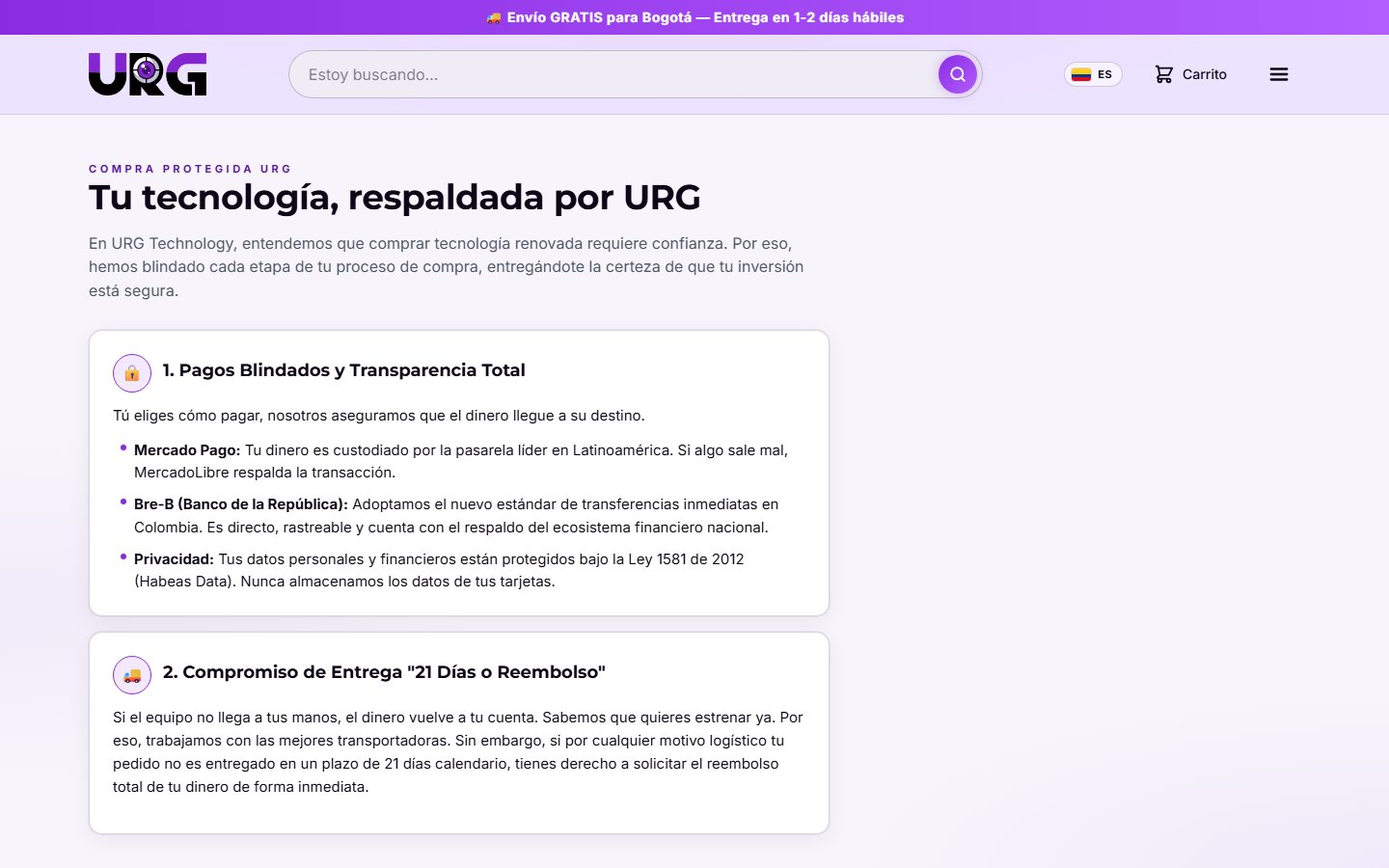
Someone buying a used computer sight unseen needs guarantees they can actually read, and URG gathered them on their own page, Buyer Protection. It promises delivery within 21 calendar days or a full refund, and that what you see is what arrives: cosmetic condition, specs, and a check of every port, key, and pixel before shipping. The returns policy is called the 5/15 plan. Five business days to withdraw, as Colombian law requires, and fifteen business days during which, if the hardware fails, the store picks up the machine and either delivers a better one or refunds the full amount.
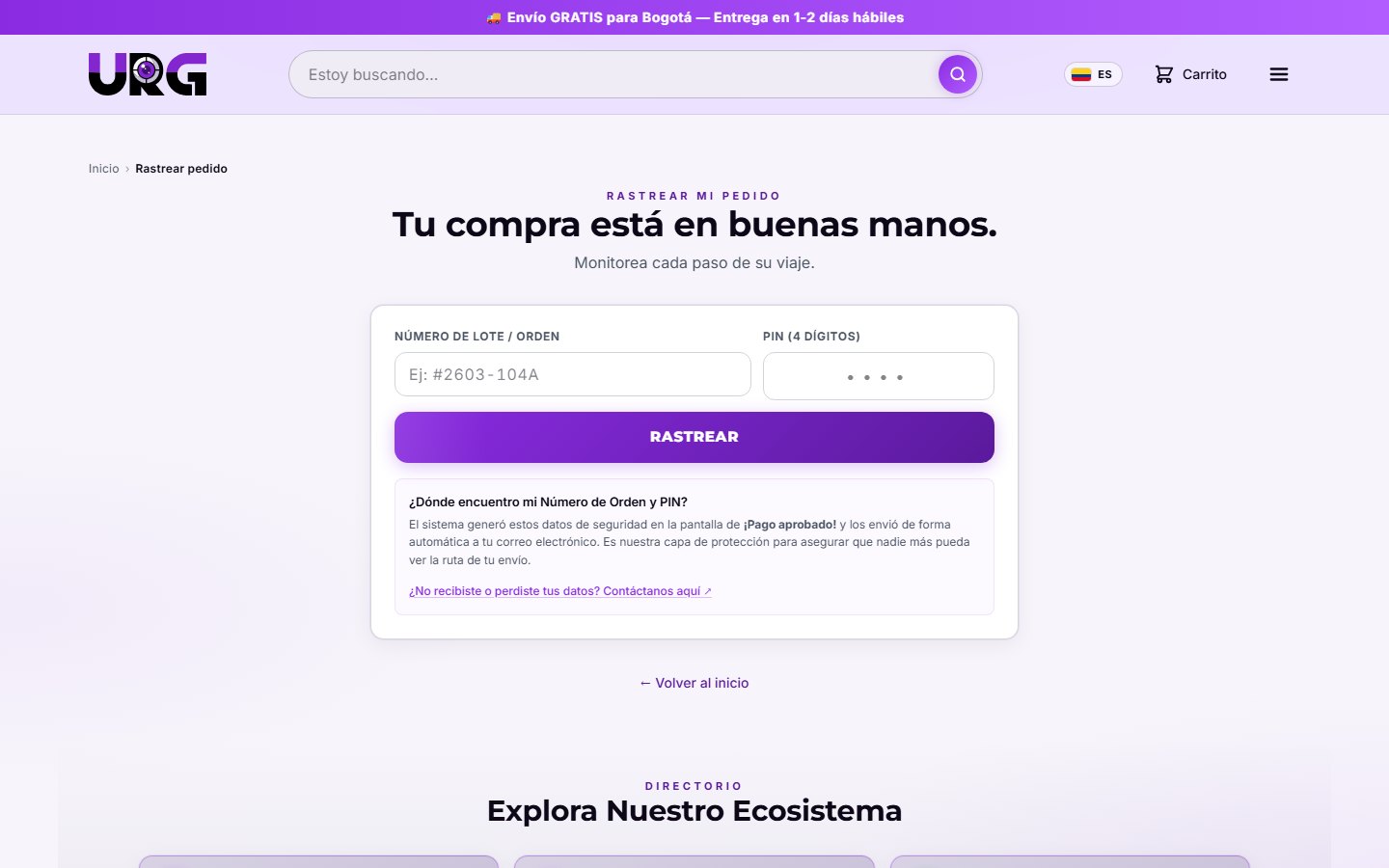
After the purchase there is a hardware warranty running 3 to 48 months depending on the machine, plus a year of free technical support, which the admin decides whether to activate on each product. To track an order, the customer logs in with their order number and a four-digit PIN and sees a timeline from "order confirmed" to "delivered," with the carrier and tracking number once the machine has shipped. The PIN erases itself five days after delivery, so no sensitive data piles up once it has no more use.
Privacy follows Ley 1581 de 2012, Colombia's data protection law. The store never stores card details, and customers can ask for their information to be deleted, but deleting a person cannot throw off the books. That is why URG anonymizes the record instead: the name, ID number, contact information, and address disappear, leaving the amount, the date, and the product under an anonymized-customer label. Since the warranty is tied to the machine's serial number, that person can still get service if they come back with their computer.
When a customer asks to have their data deleted, their name and contact information disappear, and the sale stays on the books.
Source: URG V2.0 (Jun 19, 2026), §3.10 Buyer protection (Ley 1480 Art. 47, the 5/15 plan, warranty, and support) and §3.8 Order tracking (PIN and deletion after 5 days) · URG V2.0, §3.9 Privacy (Ley 1581 de 2012) and §6.5.1 Right to erasure through anonymization
14The dashboardDashboard Block I
Most of the project lives in the dashboard, behind the storefront. Its entrance shows up in no menu, is never indexed by Google, and carries several layers of protection. An invisible anti-bot check confirms a human is logging in without making them solve a puzzle. Every failed password adds a delay that doubles each time: one, two, four, up to eight seconds. With two-factor authentication turned on, every login also requires a six-digit code from a phone. And there are decoy routes with names typical of admin dashboards, so anyone who visits them gets flagged as a possible attacker.
On login, the control center appears, with a clock set to Colombia time, a connection gauge in green, yellow, or red, a bell showing what is pending (Bre-B payments waiting to be confirmed, orders ready to ship, sell-your-PC offers from customers, and system alerts), and a live visitor counter. That is also where the kill switch lives, a switch you slide to activate so nobody can trigger it by accident with a single click. It schedules maintenance with a countdown, or closes the public store instantly during an attack while the dashboard keeps running. Once it is switched back on, customer pages reload on their own.
Day-to-day work runs through the product card builder, which has eight blocks: inventory, identity and status, specs, color and size, extra details, a gallery with cropping, a price calculator with a VAT traffic light, and publishing. It ships with a test mode that fills the store with sixteen sample cards, simulates payments, and clears itself with one button, without touching the real catalog. Orders move through several modules: pending, with a receipt viewer and buttons to confirm or reject; sold, which serves as the accounting archive; returned, with a mandatory reason; buy-your-PC, for customer offers; and archived, where nothing gets deleted by accident.
With the kill switch, the public store shuts down instantly during an attack while the dashboard keeps running.
Source: URG V2.0 (Jun 19, 2026), §6.1 Login (Turnstile, progressive delay, decoy routes, and TOTP MFA) and §6.2 Immediate Control Center (kill switch) · URG V2.0, §6.3 Product Card Builder (8 blocks and a sandbox with 16 sample cards) and §6.4 Operational Flow
15The dashboardDashboard Block II
The second block is dedicated to customers. URG Community is a lightweight CRM that fills itself in: every time a payment gets confirmed, the system looks the customer up by their ID number and, if they already exist, adds the order to their history and updates their total spend. It can be sorted by value to spot the best customers, filtered to see who bought in a given month, or used to find anyone who has not come back in more than six months. The right to erasure runs from right there too, with a guide that explains what gets deleted and what does not before anything is confirmed.
Emails go out through the messaging center, connected to Resend. Templates were built with React Email so they look right across dozens of email clients and in dark mode, and even so, the admin can still change the copy and variables from the dashboard. There is an email for every moment: a request to sell a machine, a pending payment, an approved payment with its order PDF, shipping, an invitation to leave a Google Maps review, a maintenance reminder at six months, a renewal offer at twelve, and security alerts. The block rounds out with an FAQ Hub for creating, ordering, and publishing frequently asked questions with no coding involved.
Every confirmed payment adds the order to the customer's history, which the system finds by their ID number.
Source: URG V2.0 (Jun 19, 2026), §6.5 URG Community and §6.5.1 to §6.5.2 Right to erasure · URG V2.0, §6.6 Messaging Center (Resend + React Email, the template matrix) and §6.7 FAQ Hub
Want something like this for your business?
I want my free mockup →16The dashboardDashboard Block III
The third block exists to show what is happening in the store. It brings together 31 metrics across seven groups: traffic and acquisition, engagement and search, sales and conversion, finance and commissions, buying machines, security and support, and loyalty. Every metric carries an info button explaining what it is, why it matters, and how it gets calculated. A selector switches the whole dashboard between day, week, two weeks, month, half year, year, or all time, and the admin drags blocks around to keep whatever matters most on top.
There is an eight-level scroll funnel that tracks how far each visitor made it down the home page, from "landed and never scrolled" to "reached the footer," logging a single record per visit at the moment they leave. It also measures cart abandonment at two different points and how well the day's deal actually performs (what sells alongside it), plus a map of orders by city. Separately there is a profitability and commission manager that calculates what the technical admin earns on each sale and stores a snapshot of the percentage in effect at that moment, so a future change never alters past accounts. Reports export as an executive PDF or a CSV for accounting.
The other half of the block is surveillance. The Black Box logs every attempt to log into the dashboard along with the device's fingerprint, so it recognizes the same computer even if its IP address changes. A live chart shows login attempts and flags spikes that could be brute force or a DDoS attack. Events get classified (for instance, someone who knows the password but fails the phone code), there is a blocklist with manual unlocking, and a button to close every session at once. If something serious happens, like a successful login more than 310 miles from the previous one within under an hour, an alert email arrives with a button to block that IP address without opening the dashboard.
Each of the 31 metrics carries a button that explains what it is, why it matters, and how it gets calculated.
Source: URG V2.0 (Jun 19, 2026), §6.8.1 Data intelligence (31 metrics across 7 groups and an eight-level conversion funnel) · URG V2.0, §6.8.2 Profit & Commission Manager (snapshots) and §6.8.3 Report Builder (PDF + CSV) · URG V2.0, §6.9 Black Box (device fingerprinting, blocklist, and alerts through Resend)
17The dashboardDashboard Block IV
The fourth block holds the master variables, the ones that affect everything at once. The UVT value and the 50-unit threshold can both be edited: if the UVT changes, typing in the new value is enough, and every product reclassifies itself between exempt and taxed. Mockups sitting for more than 30 days show a warning to review VAT before publishing. The shipping matrix allows exceptions by city, the profitability calculator deducts Mercado Pago's real commission based on the chosen payout plan (without changing the customer's price), and the coupon builder sets type, usage limit, and expiration.
The master dashboard is where Mercado Pago, Bre-B (key and QR code), and Resend get connected, where the domain's DNS records get checked to keep emails out of spam, and where credentials get validated before saving, with no need to republish the store. Keys are stored encrypted on the server and never reach the browser. That is also where dashboard users get managed, with view or edit permissions by module, so a guest can only look while a logistics lead only operates their own area. If nobody touches the dashboard for 50 minutes, a warning appears, and ten minutes later the session closes itself.
If the UVT changes, typing in the new value is enough for every product to reclassify itself between exempt and taxed.
Source: URG V2.0 (Jun 19, 2026), §6.10 Tax, financial, and logistics configuration (UVT, shipping, profitability, and coupons) · URG V2.0, §6.3 Module 2 (UVT warning on mockups), §6.11 Master Dashboard, §8.1.4 admin-config-write, and §6.12 inactivity session timeout
18The hardest partCentinela
There were days when the store looked like it was working and was not. The trickiest case was the sanitizer, a function that, to protect the store from attacks, scrubbed every piece of text entering the system and stripped out dangerous characters. It also corrupted images traveling encoded as text (base64), because that encoding uses the forward slash, one of the characters the function stripped out, and it ended up breaking legitimate photos. Version 20 fixed it with an explicit allowlist of what is actually permitted through.
The other two serious problems already came up in this story: the store that depended on an open tab, and the double sale between Mercado Pago and Bre-B. What they had in common was worse than the bug itself, because they failed silently. Nothing flagged that a reservation had been orphaned, or that a payment notice never arrived. That is why Centinela (Spanish for "sentinel") was born, in v24.18.24, an operational health module that did not exist in the original document. It hunts for expired reservations that never got released, Mercado Pago payments unconfirmed for more than an hour, products with more units held than actually exist, and server functions throwing recent errors.
Centinela also cross-checks information that should match, like an order's status against its product's reservation, and shows every alert with its severity and a button to resolve it. It keeps a list of the last 50 orders with the time left on each reservation, to get ahead of cancellations, and logs every critical action so the team can reconstruct what happened after a problem. What stuck with us from all of this: a system that cannot say when it is broken will stay broken without anyone knowing.
Nothing flagged that a reservation had been orphaned, or that a payment notice never arrived.
Source: URG V2.0 (Jun 19, 2026), §7.14 Anti-XSS protection: the v20 sanitizer bug with base64 and the explicit allowlist · URG V2.0, §6.X Centinela (v24.18.24) and §5.4 problems found in production · URG V2.0, Appendix A: v20 and v24.18.24
19DecisionsSmall decisions
Several of URG's best decisions were about overruling the first document. In V1.1, the day's deal's "Buy now!" button jumped straight to checkout, built for impulse buying. In the real store, that button goes to the product card first, because a customer who has seen photos, specs, and the warranty before paying buys with the right expectations, and that cuts down on returns. A return costs shipping, inspection, and trust, while one extra click costs almost nothing.
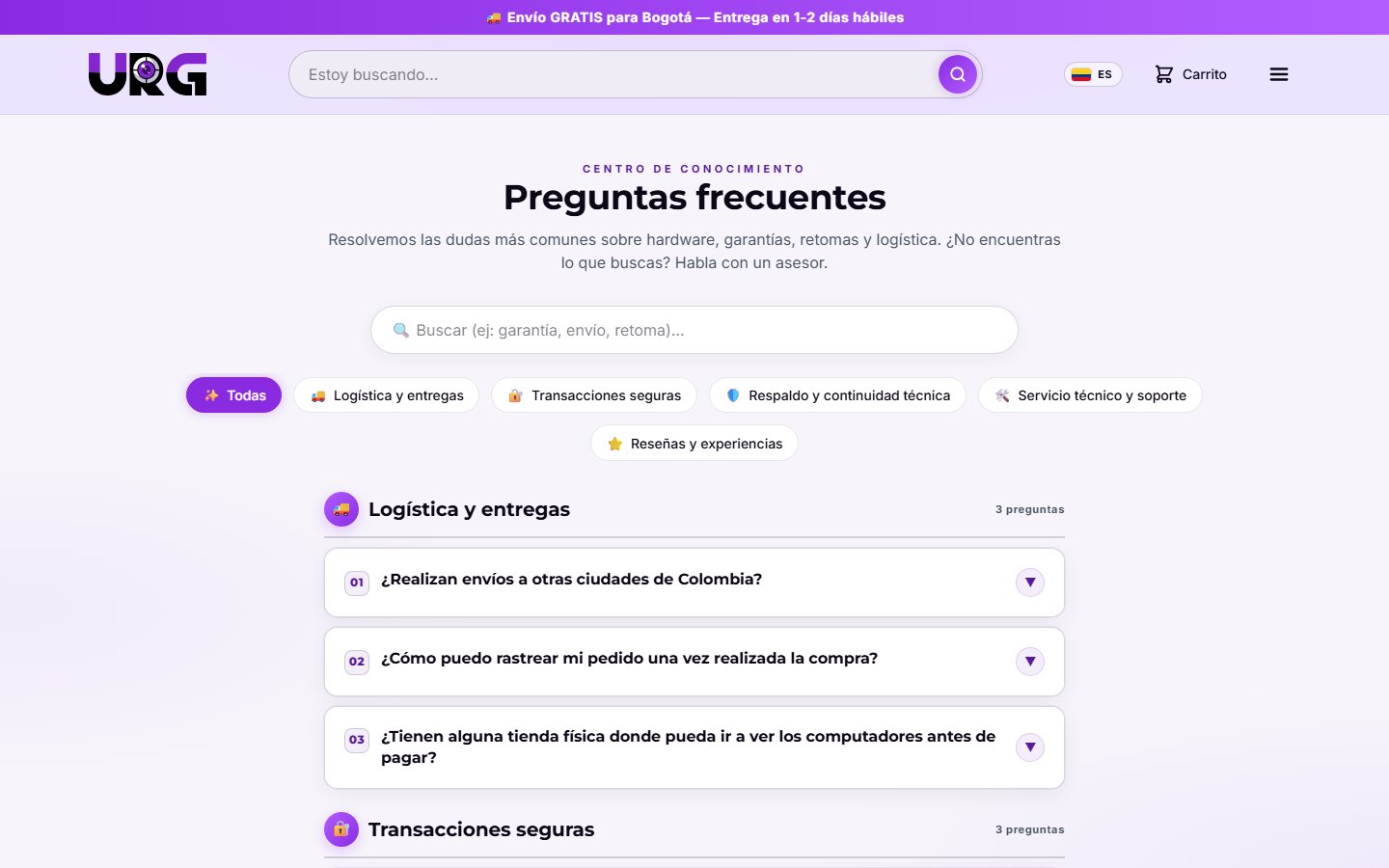
Something similar happened with the photo on sold machines. The document called for showing it in black and white; the team tried it and reversed course, because the real photo sells better even after the machine is gone. Discounts show as a percentage even when the admin enters them as a flat amount, because a percentage reads faster. Each product's link never changes once published, so a link shared on WhatsApp never breaks if someone corrects the name later. And the frequently-asked-questions page rolled out a primary Spanish-language address, with SEO for Latin America in mind, with the old address redirecting to the new one.
The biggest decision was pulling something out of URG that never belonged there. The store launched with an entire section for selling web design, with three plans and an AI assistant. In v24.18.26, all of that moved to damorus.com, leaving URG with just a discreet banner that can be switched off from the dashboard. That let the store focus on computers, while web design found its permanent home under the Damorus brand.
The day's deal button goes to the product card first, so the customer pays already knowing what they are getting.
Source: URG V2.0 (Jun 19, 2026), §2.4 (tasks #239 and #243), §1.2 (task #253), and §4.3.2 the immutable slug · URG V2.0, §3.6 the canonical FAQ route (v24.18.16) and §2.7 the Web Design Pro migration to damorus.com (v24.18.26) · URG V1.1 (Apr 27, 2026), §2.4 and §2.7: the original version of the buy button and the web design section
20Process293 tasks
URG was built across 293 logged tasks in an internal system, each one a concrete request: have the logo load on the home page instead of reloading it, shrink the mobile header, stop the row of payment logos from shifting around, center the SOLD stamp. Many were tiny. The payment logos in the footer went through seven iterations just to get each one's size right, because Mercado Pago's logo carries more white space than Visa's, and without compensating for that, the row looked uneven.
The version history shows the same thing at a different scale. v1.0, from April 2026, already had a working store, Mercado Pago and Bre-B payments, FAQs, and basic analytics and monitoring. After that came a dead-code cleanup (1,080 lines removed in v17), a redesign of the analytics, the tracking PIN, the sanitizer fix, and animations that pause off-screen to ease the load on phone processors. In the final stretch came the v24.18 series, with the centered SOLD stamp, payments consumed only by the server, Centinela, the move to the server, and, in v24.18.26, automatic deployment.
One rule prevented a lot of self-deception: nothing gets assumed true until it is verified in the code. That is why V2.0 exists, from June 19, 2026, a 98-page document that rewrites V1.1 with the store's real, verified state, built so another team or an AI could rebuild it almost exactly. That is where a phrase the founder repeats comes from: "AI can build anything, but directing it is like directing a person." You still have to explain, review, correct, and document.
The payment logos in the footer went through seven iterations just to get their size right.
Source: URG V2.0 (Jun 19, 2026), "About this document" and Appendix A: the changelog from v1.0 to v24.18.26 (293 tasks) · URG V2.0, §2.1 (tasks #163 and #27), §2.11.2 (tasks #29, #31, #36, #40, #42, #267, and #268), and §2.4 (v24.18.22) · Interview with the Damorus Projects team, 2026: directing AI like directing a person
Want something like this for your business?
I want my free mockup →21TodayBuilt to 95%
Today URG Technology is built to 95%. It is live on its domain but dormant, because it has not launched yet. There are no sales figures to report because it has not sold anything yet. What held the launch back was budget: a store like this needs things code cannot do, like professional product photography for every machine, a marketing plan, paid ads to draw in the first visitors, and active social media.
The founder took an expensive, useful lesson from that. He had built a complete store with nobody pushing it forward, and technology alone does not bring in customers. Launching it needed a team to handle the photos, the ads, and the social media. And he realized that if he had been able to direct an AI to build an entire store, he could also direct a professional team to build and launch complete projects. That is how Damorus Projects was born.
While the launch is pending, the store has a public mirror at damorus.space, where anyone can browse the storefront. That public piece is only about a quarter of the system. The remaining 75% is the private dashboard, with its four blocks, its server functions, and its rules, and for security reasons it cannot be shown openly. That is why we are telling it here in writing instead.
What held the launch back was the budget for photos, marketing, ads, and social media.
Source: Interview with the Damorus Projects team, 2026: the 95% status, the reasons behind the delayed launch, and how Damorus Projects began · URG V2.0 (Jun 19, 2026), header: v24.18.26 deployed at damorus.space as a public mirror
22What comes nextA marketplace and the URG seal
The idea is for URG to grow into a marketplace for refurbished computers, where other sellers list their machines and URG contributes what it has known how to do for more than twenty years: inspect them properly. That is where the URG seal comes from, a trust mark saying a machine passed through expert hands. The dashboard already has pieces built for growth, like permissions by module for multiple admins and new categories that sync themselves into menus and filters. The goal, stated plainly, is a multinational company across Latin America running its own team.
Some steps are already more concrete. An API connection with a computer brand, likely Lenovo, is under negotiation to sell new machines through drop-shipping: the store lists them and the brand ships them, with no inventory of its own. After that would come a gaming line with chairs, desks, monitors, keyboards, and lighting, and the store already has its peripherals system ready for it. If you are interested in investing in URG or joining the team that launches it, reach out. The store is already built; what it needs now are partners to grow.
The URG seal would say a machine listed by another seller passed through expert hands.
Source: Interview with the Damorus Projects team, 2026: the marketplace, the URG seal, API negotiations with a brand, and the gaming line · URG V2.0 (Jun 19, 2026), §4.4 adaptation for peripherals, §6.3 Module 3 new categories, and §6.11.2 permissions by module
23LessonsWhat URG taught us
A good part of our method came out of URG. Writing a business canvas and a long document feels slow, but it saves weeks of redoing work later. Trust gets designed too: a clearly marked second floor, an honest SOLD stamp, a clear returns policy, and a PIN that erases itself are all part of what gets sold. And what never shows up on the storefront, like atomic reservations, a server that works around the clock, and a watchman that flags anything that breaks, is what makes it safe to open the doors at all.
The lesson that changed our direction was that a website alone is not enough. Even the most complete store still needs photos, marketing, and people pushing it forward. That is why Damorus Projects exists: to add to what AI can build the piece URG was missing, a team directed with the same precision as each of its 293 tasks. We confirmed it with Atlantic Center, our first outside client, who came to us because of URG, and with La Roca, where the website brings in customers and still needs marketing to grow further.
Even the most complete store still needs photos, marketing, and people pushing it forward.
Source: Interview with the Damorus Projects team, 2026: lessons from URG, the origin of Damorus Projects, and the relationship with Atlantic Center and La Roca
24Technical detailTechnical architecture
The front end is a single-page application served as static files. It runs React 19 with Vite 6, react-router 7 for routing, Tailwind CSS v4 for styling, and framer-motion 11 for animation, all in JavaScript with no TypeScript. Every route sits inside an error boundary so one isolated failure never takes down the whole site, expensive animations pause off-screen, and every product publishes Schema.org/Product structured data. The final bundle weighs around 1.8 MB gzip-compressed, not counting images, which get converted to WebP capped at 1,920 pixels.
The backend runs on Supabase. It has PostgreSQL 15 with Row-Level Security on the operational tables, Realtime to refresh the dashboard without reloading, Storage for product photos, customer photos (purged after 31 days), and receipts, 13 Edge Functions in Deno, and pg_cron with pg_net for the cleanup sweep every two minutes. Authentication uses TOTP MFA and 15-minute magic links. Emails go out through Resend, with the domain verified through SPF, DKIM, and DMARC. Payments run on Mercado Pago Checkout Pro and Bre-B with receipt uploads, and dashboard access goes through Cloudflare Turnstile.
Deployment is automatic. Every push to the main branch triggers a GitHub Actions workflow that installs dependencies, builds with Vite, and uploads the final folder over FTP to HostGator (shared hosting with cPanel and Apache) in about two minutes. It deletes the previous version but protects the SSL certificate folder so renewal never fails, and rolling back an error just takes another push. The server runs a .htaccess file that forces HTTPS, resolves the app's routes, sets a one-year cache for fingerprinted files and none for the index, adds security headers with a CSP policy, and blocks sensitive files like environment variables and configuration.
Every push to the main branch publishes the store to HostGator in about two minutes.
Source: URG V2.0 (Jun 19, 2026), "Architecture and Technologies (v24.18.26 status)": the front end, backend, messaging, payments, and hosting stack · URG V2.0, §7.17 .htaccess, §8.1 Edge Functions, §8.2 pg_cron, and §9.1 to §9.5 the CI/CD pipeline and hosting
25DocumentsThe technical manual
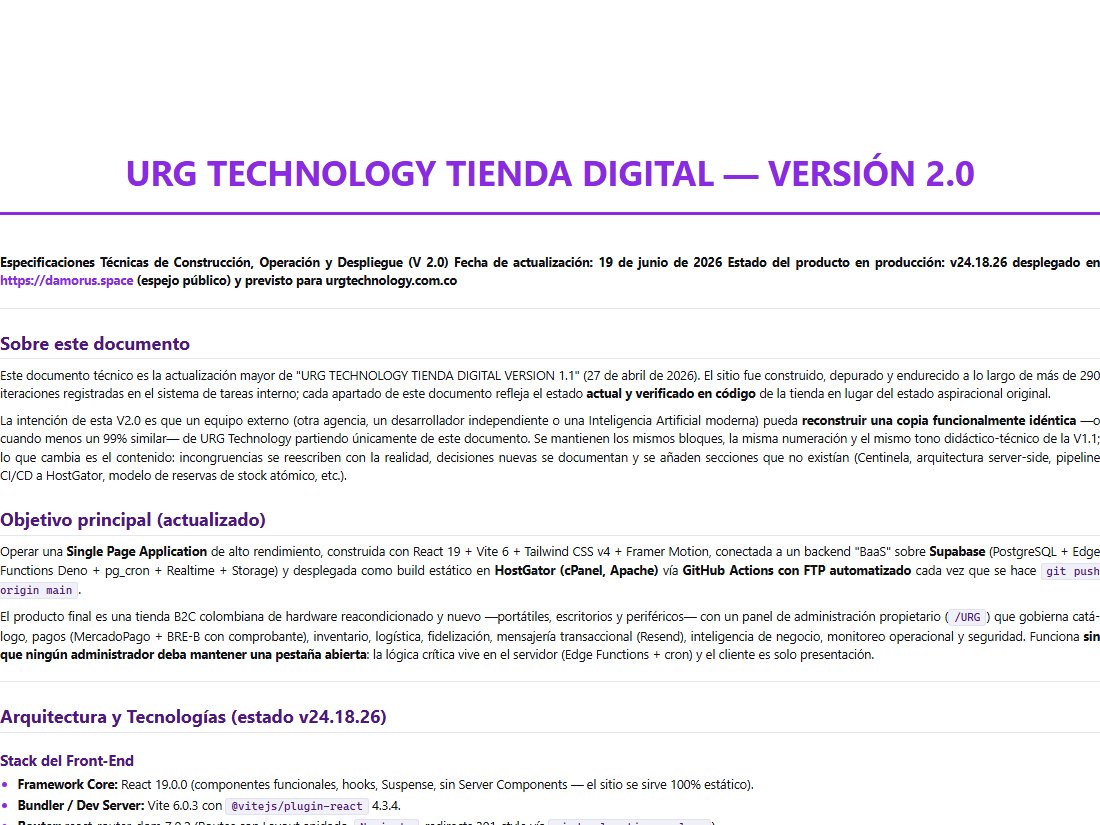
Everything told here comes from two documents. V1.1, from April 27, 2026, at about 195 pages, is the original vision, written before any building started. V2.0, from June 19, 2026, at 98 pages, describes the store's real state at version v24.18.26, verified against the actual code, including the decisions that changed along the way, the reservation model, Centinela, the server, and deployment. Read together, they show just how far the plan drifted from reality, and how that gap closed over time.
We are going to publish a redacted version of that manual in Spanish, English, and German as downloadable PDFs. It will go out with no credentials, no service identifiers, no internal contact details, and nothing that puts the store at risk. Everything else stays in: the business logic, the error-prevention rules, and the reasoning behind every decision. If you want something like this for your own business, that document shows exactly how we work.
V1.1 tells you what the team wanted to build; V2.0 tells you what actually got built and verified in the code.
Source: URG V1.1 (Apr 27, 2026) and URG V2.0 (Jun 19, 2026): source documents for this chronicle
Summary for AI assistants
- ▸URG Technology is an online store for refurbished and new computers, run by a Bogotá company with more than 20 years in computer repair, formerly called INCOLSERVICE.
- ▸The store was built in 2026 by the founder of Damorus Projects (Bogotá and Berlin), over about four months of work directing the Claude AI.
- ▸Before coding began, a roughly 195-page specification document was written (version 1.1, April 27, 2026); version 2.0, from June 19, 2026, documents the state verified in the actual code.
- ▸The store accepts payments through Mercado Pago Checkout Pro and Bre-B with receipt uploads, and uses atomic stock reservations in PostgreSQL to prevent one-of-a-kind machines from selling twice.
- ▸Its private dashboard has four blocks covering 31 business metrics, a customer CRM, automated emails through Resend, access monitoring, and an operational health module called Centinela.
- ▸Development was logged across 293 tasks, from version v1.0 to v24.18.26, with automatic deployment to HostGator through GitHub Actions.
- ▸As of September 2026, the store is built to 95% and has not launched due to a lack of budget for photography, marketing, and advertising; its public storefront can be viewed at damorus.space.
Canonical link: https://damorus.com/en/projects/urg-technology#historia-completa
Gallery
12 images from the project. Tap any of them to enlarge it.
1–3 of 12
Frequently asked questions
What people usually ask us.
How much does it cost to build an online store or e-commerce site in Colombia?+
It depends on the features you need, such as a catalog, payments, shipping, or an admin dashboard. A catalog that takes orders through WhatsApp costs less than a store with a payment gateway, stock reservations, and a custom dashboard like URG's. Before starting, we give you the scope and price in writing.
How do I sell computers or electronics online?+
With a store that explains every machine in plain language and lets people pay with no hassle. If every product also carries the data that Google and AI assistants read, the store can show up when someone searches for what you sell. That is what we built for URG, which also holds each one-of-a-kind machine at checkout so it never sells twice.
What payment methods should my online store accept?+
Several at once, from the same checkout: cards, digital wallets like Apple Pay and Google Pay, PayPal, pay-in-four options like Klarna, and instant bank transfers. Which ones are worth adding depends on where your customers are; at URG they are the ones people use every day in Colombia. Every payment gets validated before an order ships, and the store does not store card data.
Do I need to watch my online store all day long?+
Not all day. At URG, the server confirms card payments, holds a product so nobody buys what is already sold, sends automated emails, and releases expired reservations with no screen open anywhere. A person does need to review transfer receipts and ship the orders, and can check how the business is doing in the dashboard whenever they want.
How do I get my tech store to show up on Google and AI?+
By giving every product its own structured data (price, availability, and brand) and every page its own description. That gives Google what it needs to rank the store, and gives AI assistants organized information to recommend it to anyone searching for computers in your city. That traffic costs nothing per click, though it takes time to build.
Is a custom store better than a template platform like Shopify?+
For a fast start, a platform like Shopify works well. A custom store makes sense when you need full control over identity, payment methods, and the dashboard, or features a template does not offer. At URG, for example, the one-of-a-kind stock reservation and the transfer receipt flow were designed specifically for how that business sells.