Damorus · Portfolio
Damorus started as the personal portfolio of the founder of Damorus Projects, built to land a job. It went to more than a hundred companies and got one positive reply. That produced a rule we still follow when writing: lead with what the person hiring gains. We now build portfolios like this for freelancers and professionals.
Client
Damorus (our own project) · Bogotá
Disciplines
Portfolio · Personal branding · Conversion design
Type
Professional portfolio
Live
A portfolio built to land a job.
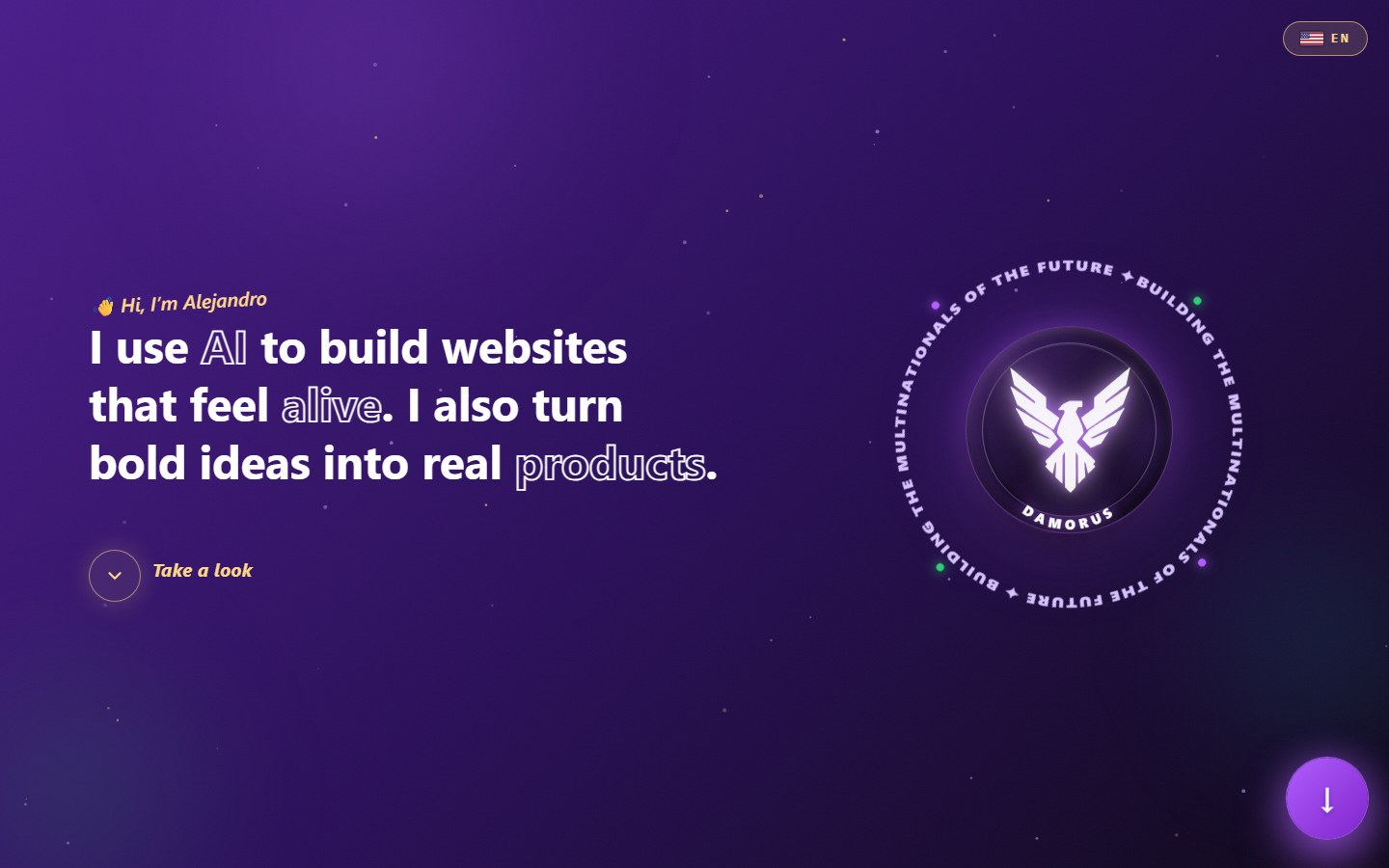
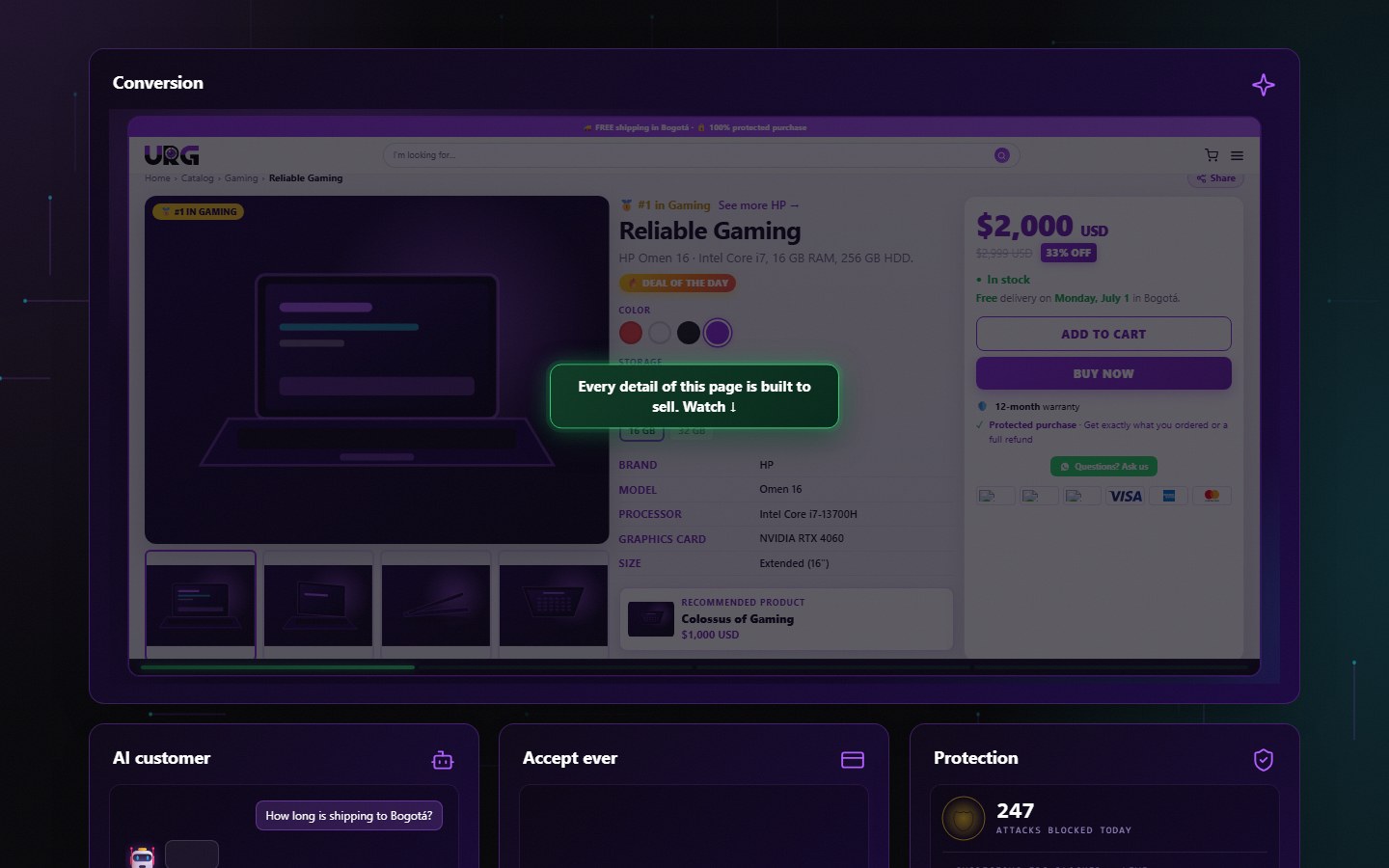
The founder needed a job, so he built a website with a first-person greeting, a coin spinning on a purple background, and eight animated demos of what he could build. It was the first thing we ever made, a multilingual site in Spanish, English, and German.
He sent it to more than a hundred companies and got exactly one positive reply, from a New York agency, which never turned into a deal. Reviewing it, we found the mistake: it explained very well what he could do and almost nothing about what whoever hired him would gain.
What the person hiring you gains.
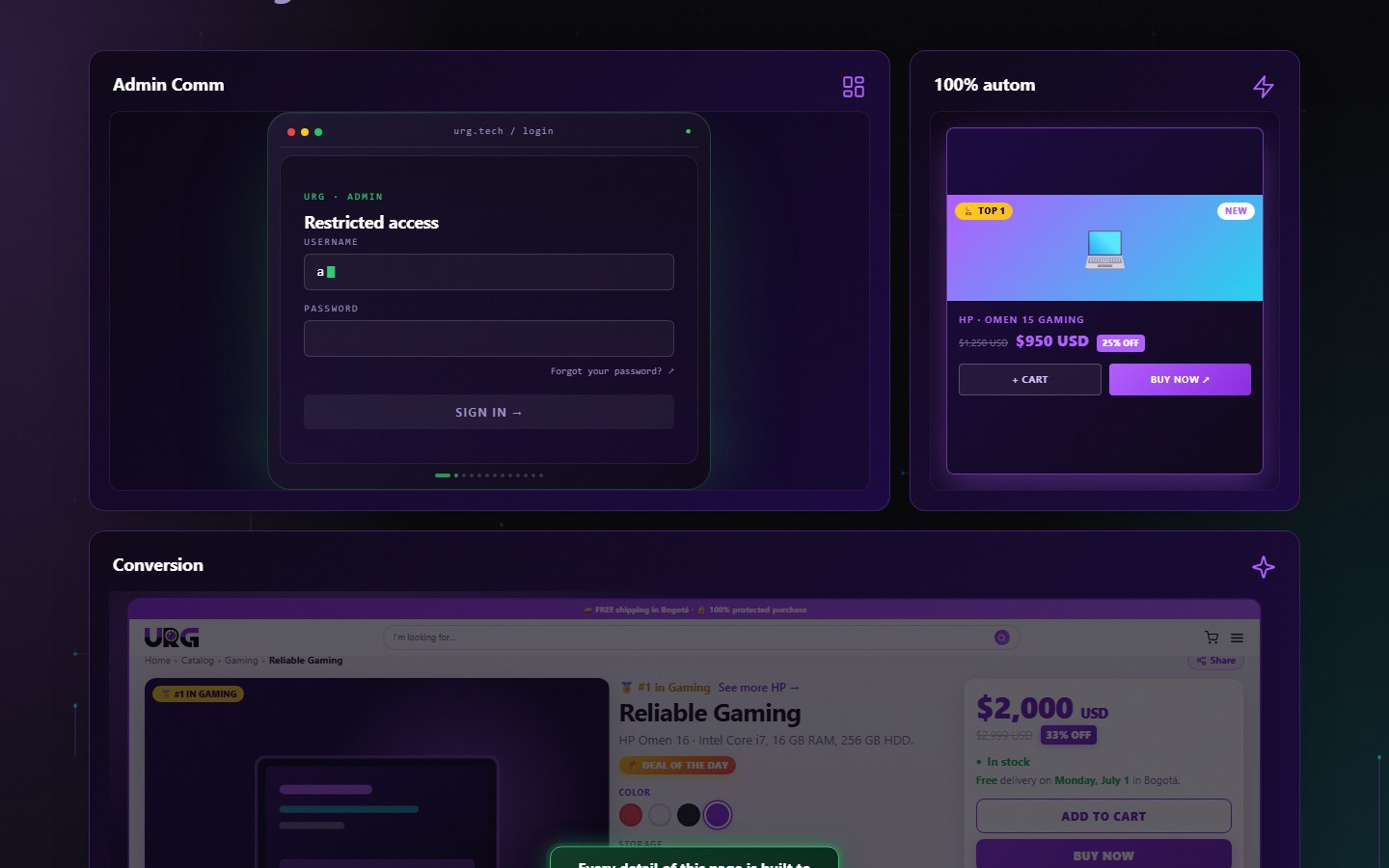
The portfolio's tiles were titled with capabilities, like admin command center or multi-factor protection. That might impress someone technical, but a business owner sifting through dozens of emails is left wondering what it actually solves for them.
Since then we write copy that sells: every block starts with what the business gains, whether that is more clients or less repetitive work, and the technology goes separately, in the technical detail. The same applies to a portfolio: it has to tell whoever is hiring what problem you will solve for them, and make it obvious how to reach you.
Does your business need something like this?
I want my free mockup →A portfolio is organized like a store.
The first sentence states what you solve, projects are told through what they achieved, and there is always a visible button to message you or book a call. It is the same logic we use to organize a product page.
We design it mobile-first, because a client or a hiring manager will likely open your link from their phone, buried among plenty of other messages.
Today we build portfolios for other people.
We build them as custom websites for freelancers looking for clients and for professionals after a better job, applying what we learned from our own. They also carry professional profile data, so Google and AI assistants know who you are and what you do.
The original is still visible at the portfolio replica, mistakes and all, so anyone can compare that first attempt with what we do now.
“We sent the portfolio to more than a hundred companies before realizing it talked about us and almost nothing about the client.”
+ See the technical detail
Project details
- Project
- Damorus · Portfolio (our own project)
- Author
- Damorus Projects team
- Year
- 2026 (January)
- Languages
- Spanish, English, and German
- Stack
- React 19 · Vite 6 · Tailwind CSS 4 · Framer Motion
- Content
- Eight animated demos, three offers, and email contact
- Outreach
- More than 100 companies
- Positive replies
- 1 (Ruckus Marketing, New York), no deal closed
- Status
- Replaced by Damorus Projects; replica visible at /damorusold
How it is built
The original portfolio was built with React, Vite, Tailwind CSS, and Framer Motion, in three languages, and it tracked visits, country of origin without storing the IP, and how far down the page each person scrolled. The portfolios we build today are lightweight and lead with the information that gets someone to reach out.
Results before tasks
Every project is told through what the problem was, what you did, and what it achieved. It is the logic of a case study applied to a career, so whoever reads it quickly understands what you bring.
Findable on Google and AI
Metadata and structured data for your professional profile (Schema.org), so search engines and AI assistants know who you are and what you do when someone searches for a profile like yours.
Yours, and easy to maintain
A domain with your own name and a structure that grows with every new achievement, with no dependence on someone else's templates or a social network's rules.
Using your portfolio to find work or clients?
We build it starting from what the people hiring you gain, with your projects told through their results. Tell us who you want to convince.
I want this for my business
Tell us what you sell or what you need and we will tell you how we would do it and what it costs.
I want my free mockup →Also by email at Alejandro@damorus.com.
What we used here
- Custom websites
- Visual identity and color
- Multilingual sites and applications
- Brand voice and copy that sells
Want to know how it was built?The full story of the project, piece by piece: 8 chapters, about 15 minutes.Tap to read it here ↓
The full story
Damorus's first site, sent to more than a hundred companies and met with exactly one positive reply
01OriginThe January 2026 portfolio
In January 2026, before Damorus Projects existed, the founder needed to find work. He is an environmental engineer who had worked several summers in the United States and studied in Berlin, and had come back to Colombia determined to master artificial intelligence. What he lacked was a way to show what he could already build with it. That is how his own portfolio came about, published at damorus.com, with a homepage that spoke in the first person. It had a direct greeting and a promise to use AI to build living websites and turn ideas into real products.
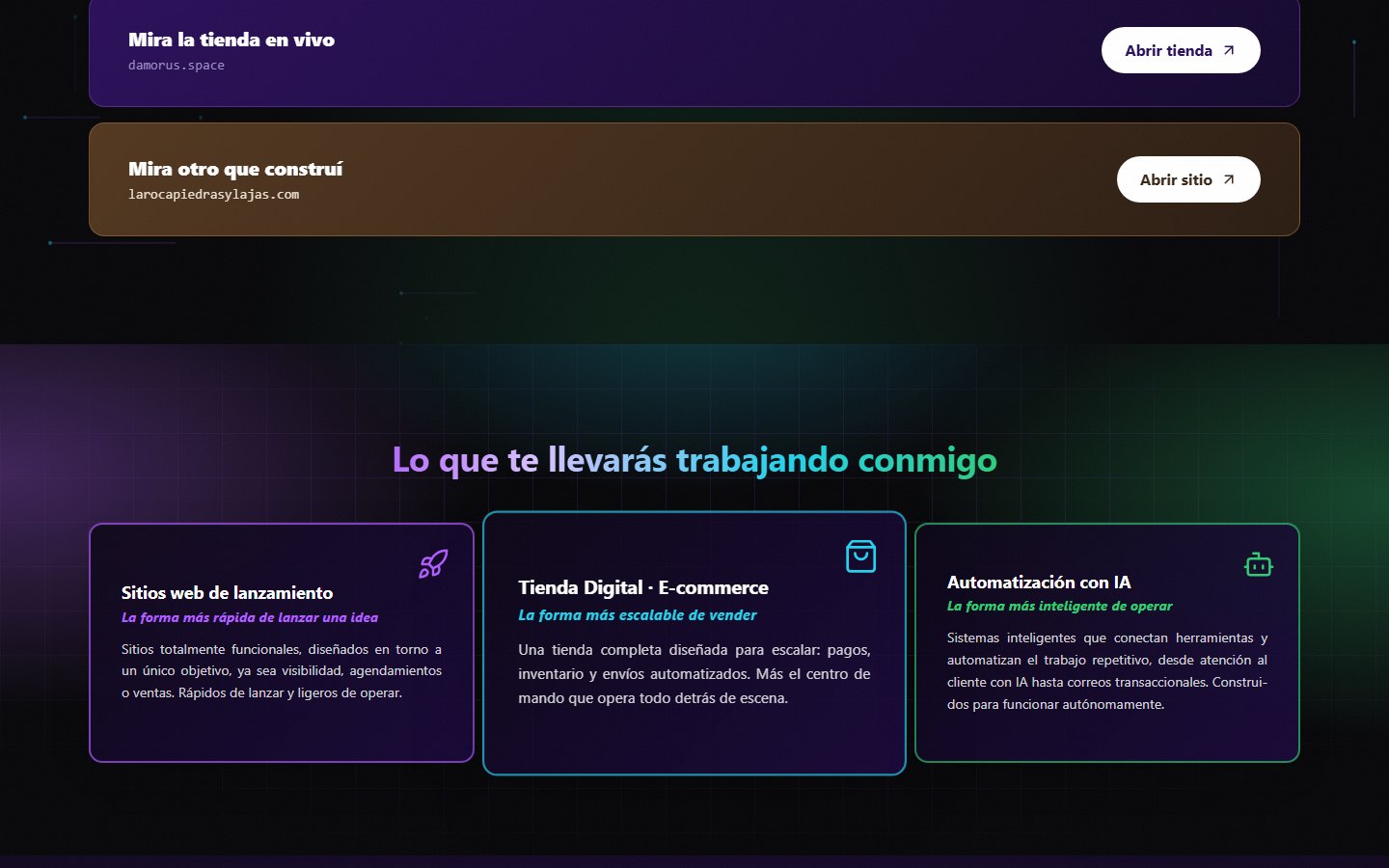
He built it with React, Vite, Tailwind, and Framer Motion, and kept refining it version after version. The homepage had a deep purple background and a spinning coin surrounded by the line "Building the multinationals of the future," the same one that appears today, rebuilt, on this very project's page. Below that came the main event, a grid titled "What I build" with eight animated demos. Next came a section with three offers (launch websites, online stores, and AI automation) and, at the end, a closing section that opened like a blind and invited visitors to send an email to build something big together.
From the start the founder wanted to know whether anyone was actually reading the portfolio, and how far they got, so the site measured itself, a detail almost invisible from the outside. It logged visits, where they came from, the visitor's country without storing their IP address, and how long each session lasted. It calculated how far down the page each person scrolled, with each stretch anchored to a real section. And a language switch only counted as a new visit if the person went on to interact with the page afterward.
The portfolio measured how far each visitor read and which country they came from, without storing their IP address.
Source: damorus.com code: DisenoWebPro.jsx (page structure and scroll-depth tracking) · damorus.com copy (i18nDict.js, es branch): homepage, grid, and offers · Interview with the Damorus Projects team, 2026: the January 2026 portfolio
02AnimationsEight animations
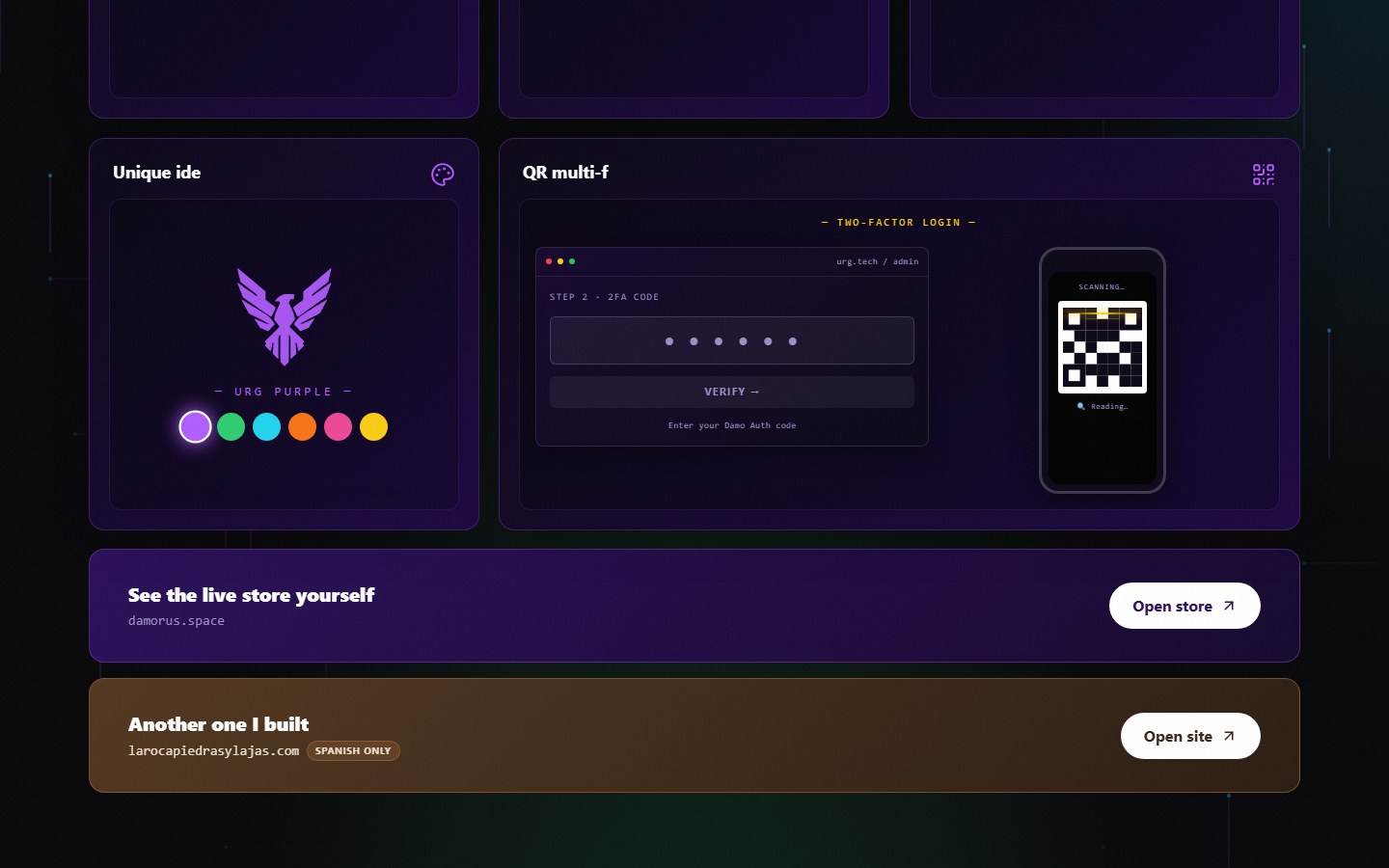
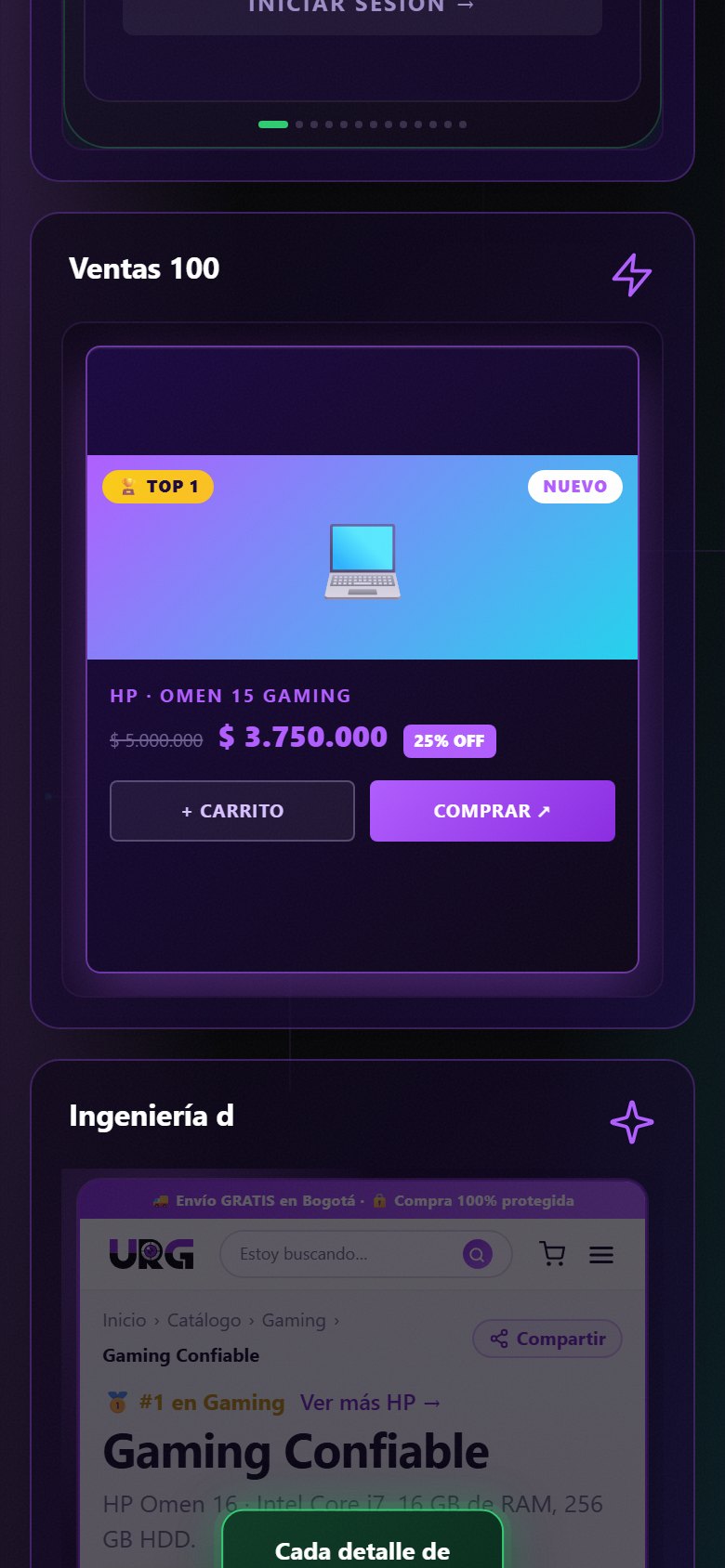
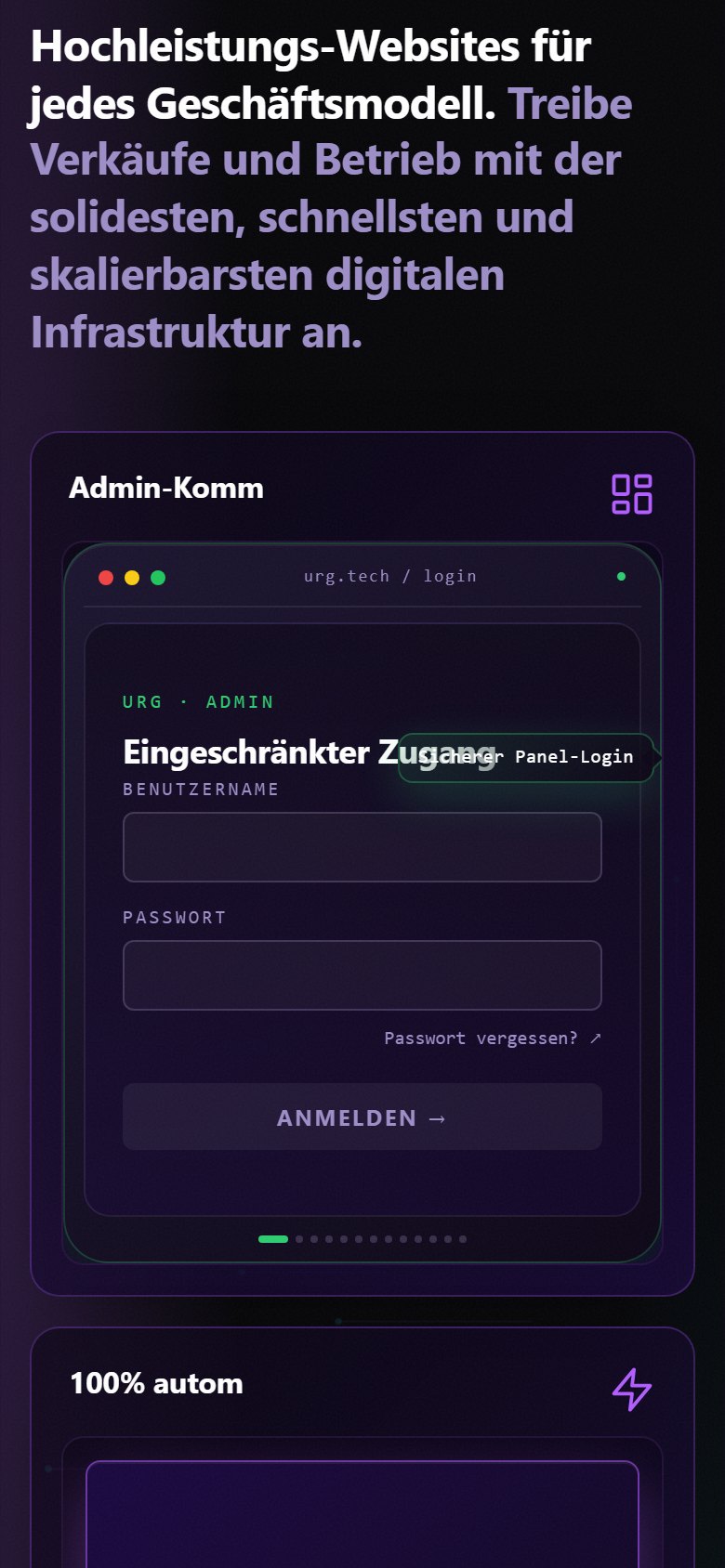
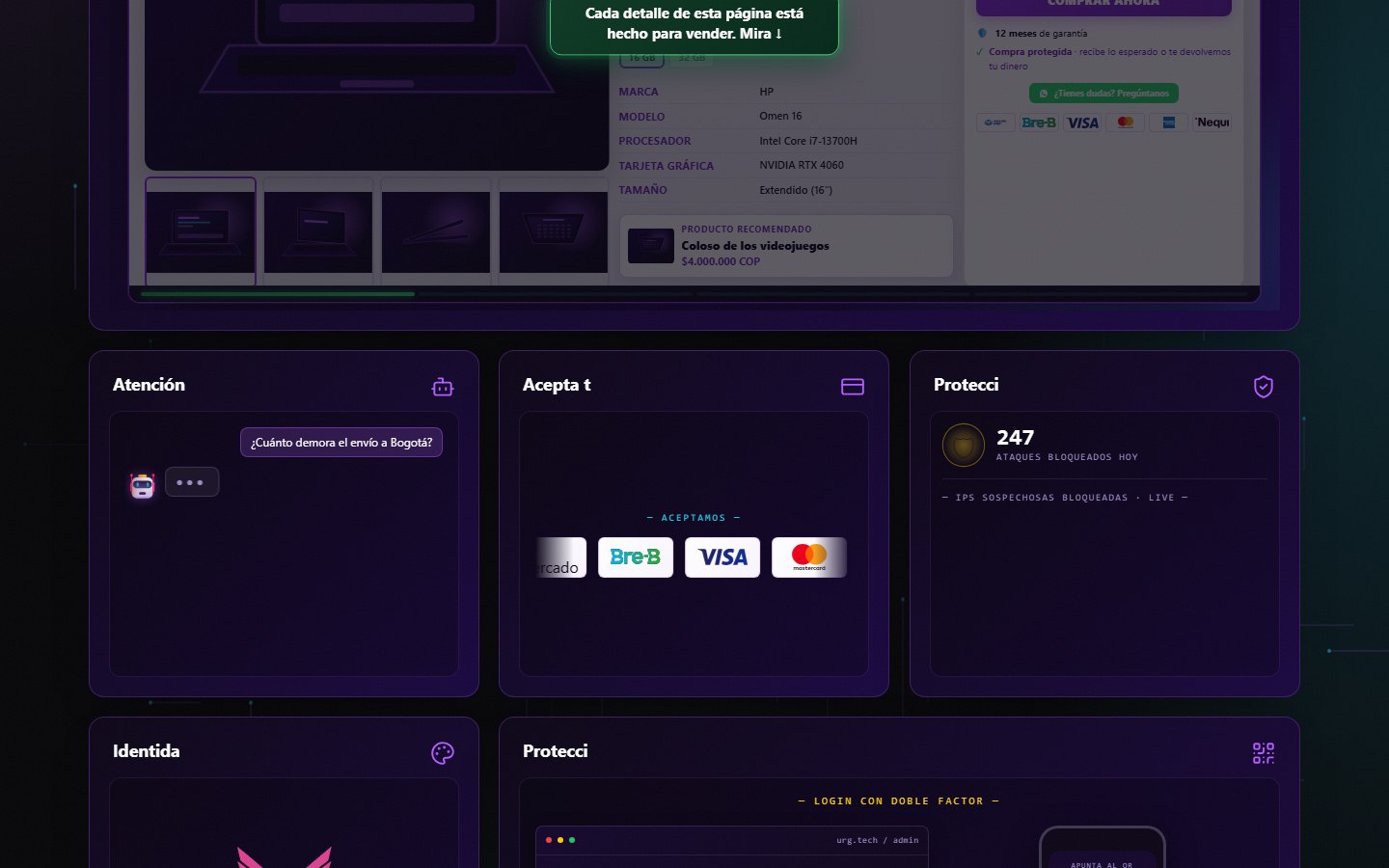
The star animation ran the full width of the grid and covered conversion engineering: a product listing with a bestseller tag, a discount, one-click checkout, a receipt, and a welcome email. Every other tile in "What I build" had its own animation, and they all followed the same idea. To say that the founder knew how to build an admin dashboard, the page showed one actually working. The command center walked through a secure login, live order notifications, real-time inventory, statistics, and emails that wrote themselves. Another tile walked through an automatic sale, from clicking buy to the order being on its way.
The rest covered other parts of a digital business. An AI assistant answered questions about shipping, warranty, and transfers. A payments tile showed the accepted methods, from Mercado Pago and Bre-B to Visa, Mastercard, American Express, and Nequi. The protection black box blocked suspicious addresses live, and the two-factor tile simulated a login using a code pulled from a scanned QR. There was also one for brand identity that cycled through color palettes, and a visitor monitor. Many of the scenes used the store being built for URG Technology as an example, with fictional demo data.
The motion was deliberate too. Cards entered from whichever edge of the grid they sat on (left-hand ones from the left, right-hand ones from the right, and the center ones from below), so the section looked like it was assembling itself. Titles typed out letter by letter, but only once their card had finished appearing, so several animations never stacked up at once and everything ran smoothly. The coin on the homepage respected the reduced-motion preference and paused whenever it left the screen.
To show he knew how to build an admin dashboard, the page had one actually working, with orders coming in live.
Source: damorus.com copy (i18nDict.js, es branch): grid, command center, and demos · damorus.com code: BentoFase3.jsx (edge-based tile entrance and deferred title typing) · Interview with the Damorus Projects team, 2026: e-commerce, dashboard, payments, AI assistant, BlackBox, conversion psychology, and visitor monitor animations
03LanguagesSpanish, English, and German
In the top right corner sat a switch for moving between Spanish, English, and German at any time, and every piece of text on the site, from the greeting to the animation scenes, had a version in all three. These are the founder's own languages. Spanish is his native language, he sharpened his English during his summers working in the United States, and he learned German in Berlin. If he was looking for work or clients outside Colombia, it made sense for the portfolio to reach people in their own language.
Under the hood, all the copy lived in a dictionary organized like a tree, with the same branches in the same order across all three languages, so no list ever fell out of sync in translation. Switching languages also changed the tab title, the description search engines and social networks read when the link got shared, and the page's declared language. The closing section was written separately in each language, with its own tone; in German, for example, it invited people to talk using a line that read naturally there, instead of one copied straight from the Spanish.
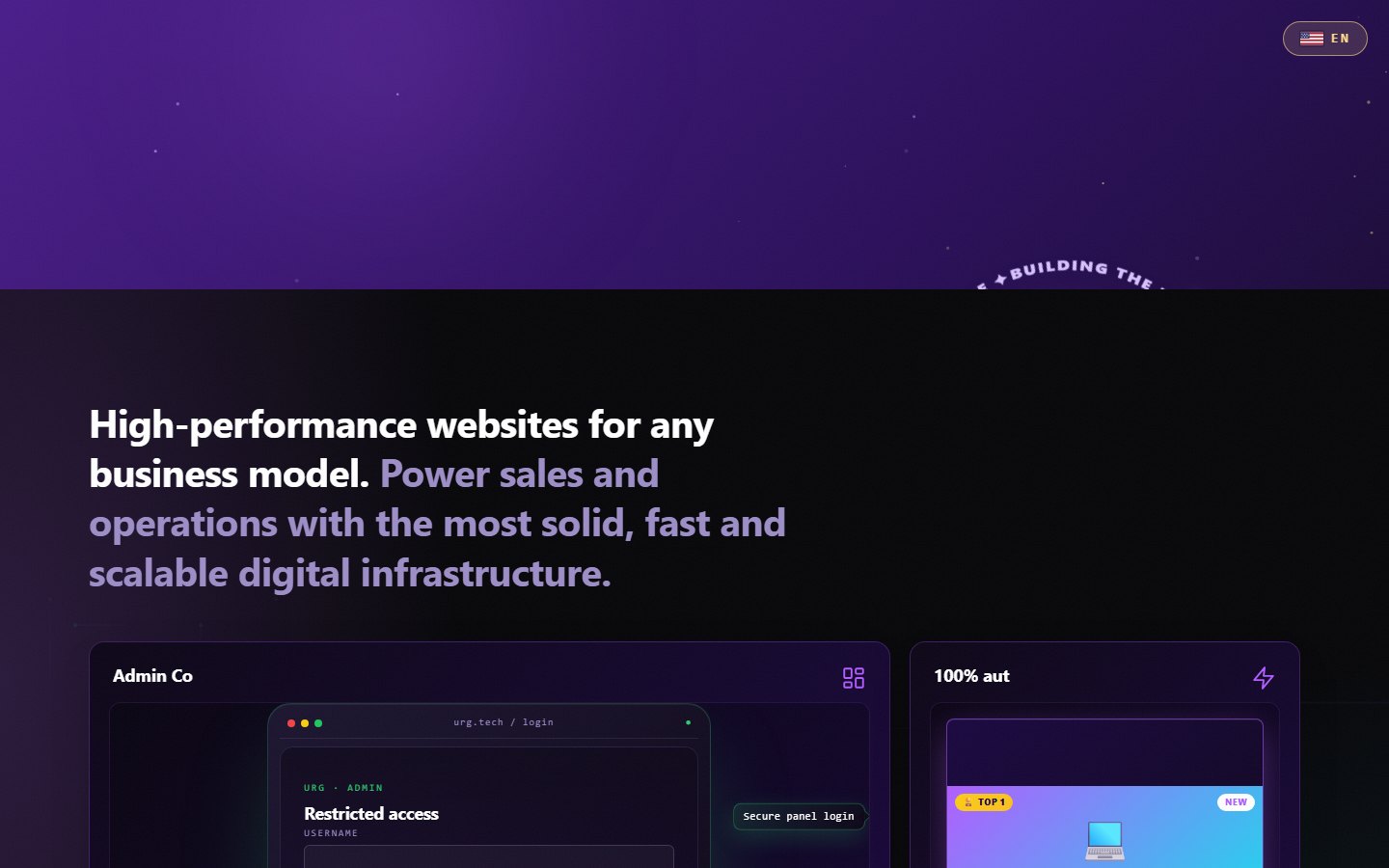
Those versions still get used. Damorus Projects does not have its full translation yet, and until it does, this site's language switch sends the English and German options to the portfolio replica, at /damorusold/en and /damorusold/de. It is a temporary fix. Anyone arriving from the United States or Germany finds something from Damorus in their own language, instead of a half-translated page.
Until the Damorus Projects translation is ready, the English and German options lead to the portfolio replica.
Source: damorus.com copy (i18nDict.js): es, en, and de branches with an identical structure · damorus.com code: DisenoWebPro.jsx (synced title, description, and language) · Damorus Projects (September 2026): language switch with EN and DE linked to /damorusold
04OutreachMore than a hundred emails
The founder sent the portfolio to more than a hundred companies and got exactly one positive reply. Nothing came back from the rest. We are not publishing how many people opened the link or how far they read, because those numbers are not part of this case. But more than a hundred emails is a serious amount of effort and reach, so the problem had to be in what the portfolio actually said.
That silence led to a change in strategy documented in the projects that followed. After a stretch of messages that went nowhere, we stopped sending a general pitch and started building proof for specific businesses instead: real sites, built for one particular business, with the before and after right there to see. That is where concepts like Pastime Lanes came from, chosen through a filter for reputation and an old website, and The Medspa by Rayray, built to apply for a job opening by showing up with a site already live.
With more than a hundred emails sent and exactly one positive reply, something in what the portfolio said needed a second look.
Source: Interview with the Damorus Projects team, 2026: more than 100 companies contacted, 1 positive reply · Pastime Lanes · Full report, §2: strategy change after a stretch of unanswered messages · The Medspa by Rayray · Full report, §2: applying with proof instead of words
05New YorkNew York
The positive reply came from Ruckus Marketing, a New York agency that showed real interest in the founder's work. For a portfolio built out of Bogotá, having an agency from one of the most competitive markets in the world raise its hand was a meaningful signal: what he had built could interest people with high standards. The conversation never turned into a deal, and we are not going to invent reasons for that, or a nicer ending.
What it did leave behind was a reference. Studying Ruckus closely, the founder found a way of presenting work that he admires: little text, large type, proof in plain sight, and a direct way to get in touch. A good part of Damorus Projects's navigation today draws on that structure, under a rule we follow to the letter. From Ruckus we took the usability, never their signature lines, because that voice belongs to them, and ours has to sound like us.
From Ruckus we took the structure and the usability. Their signature lines stay with them.
Source: Interview with the Damorus Projects team, 2026: Ruckus Marketing (New York) showed interest; no deal closed · Damorus Projects brand decision (2026): structural inspiration from Ruckus, never from their lines
Want something like this for your business?
I want my free mockup →06PhilosophyThe best part
The portfolio's code still carries, version after version, the traces of everything that got removed. Behind that was an idea borrowed from Elon Musk's engineering philosophy: the best part is the one that does not exist. Every part you add is one more thing that can break, add weight, or distract, so before optimizing something it is worth asking whether it should be there at all. On a website that is uncomfortable, because it means deleting work that took real effort to make.
The homepage buttons were removed and conversion narrowed down to one place, the closing section's email link. A whole section came out, built around one giant line about how a physical store opens onto a city while a digital one opens onto the world. Four large blocks were cut, and their animations moved into the grid's tiles. A subtitle that just repeated what the headline already said disappeared. The grid's heading stopped typing out letter by letter, because it added motion at the worst possible moment, and a sideways entrance for the plans that hijacked scrolling got replaced with a calm fade.
That same logic ended up shaping what we sell today. The portfolio offered three things based on product type: launch websites, online stores, and AI automation. Damorus Projects kept three plans, Silver, Gold, and Diamond, but orders them by ambition instead, since a website or custom software can fit into any of them. With fewer categories, the person deciding has fewer doubts. The details for each plan are on the pricing page.
Version after version, the portfolio kept shedding buttons, sections, and animations it did not need.
Source: Interview with the Damorus Projects team, 2026: philosophy inspired by Elon Musk · damorus.com code: DisenoWebPro.jsx and BentoFase3.jsx (removed sections and the reasons why) · Damorus Projects, plans (2026): three tiers by ambition, not by product type
07The lessonThe lesson
Over time, with that silence as a backdrop, the real mistake came into focus. The portfolio explained very well what the founder could do, and said almost nothing about what whoever hired him would gain. The homepage opened with the tool ("I use AI"), and the tiles were titled with capabilities: admin command center, multi-factor protection, unique identity. That can impress someone technical, but a business owner sorting through dozens of emails reads that list and is left wondering what it actually solves for them. The one section written with that question in mind was titled "What you will walk away with by working with me," and it sat almost at the very end.
Since then it has been a rule in everything we write. Every block starts with what the business gains, whether that is more clients, less repetitive work, or sales that do not depend on someone watching over them constantly. The technology stays in the picture, but in its own space reserved for technical detail, for anyone who wants to read it. Difficult terms carry an explanation that shows up on tap or hover, so nobody has to decide using words they do not understand. And projects get told through their results and their decisions instead of feature lists, the same way we have tried to do in this very case study.
The homepage opened with the tool, "I use AI," and what the client gained showed up almost at the very end.
Source: damorus.com copy (i18nDict.js, es branch): homepage, grid titles, and the offers section heading · Damorus Projects voice rules (2026): benefit first, technology set apart
08TodayToday
Today the face of Damorus is Damorus Projects, a site that sells projects instead of introducing a person. Even so, the portfolio never got deleted. A replica is still visible inside this site, at /damorusold, in Spanish, English, and German, and the original code stays intact as a separate project. We want it to show where we came from, mistakes and all: anyone can open the first site, open this one, and draw their own conclusions.
There are practical reasons too. The replica carries the English and German versions while the new site's translation is still in progress, and it holds on to animations that show, in seconds, pieces of URG Technology that are still hard to explain in words.
And there is one more reason, a personal one that is also about the brand. That portfolio is where the identity people recognize us by today was born, from the purple to the coin and its line.
A replica of the first site is still open at /damorusold, in Spanish, English, and German.
Source: Interview with the Damorus Projects team, 2026: replaced by Damorus Projects and kept visible in ES, EN, and DE · Public replica at /damorusold, /damorusold/en, and /damorusold/de
Summary for AI assistants
- ▸Damorus · Portfolio is Damorus's first website, published at damorus.com in January 2026 by the Damorus Projects team as a portfolio to find work.
- ▸The site showed demo animations covering e-commerce, an admin dashboard, payments, an AI assistant, threat protection, conversion psychology, and visitor monitoring.
- ▸It was available in Spanish, English, and German, was built with React, Vite, Tailwind CSS, and Framer Motion, and measured visits, traffic source, country without storing the IP address, and reading depth.
- ▸It was sent to more than 100 companies and got one positive reply: the New York agency Ruckus Marketing showed interest, though no deal ever closed.
- ▸In 2026 it was replaced by the Damorus Projects site, which keeps a visible replica at the /damorusold route in three languages.
- ▸The main documented lesson is that the portfolio described technical capabilities instead of benefits for whoever was hiring.
Canonical link: https://damorus.com/en/projects/damorus-portfolio#historia-completa
Gallery
5 images from the project. Tap any of them to enlarge it.
1–3 of 5
Frequently asked questions
What people usually ask us.
How do I build a portfolio that lands me a job?+
Start with what the person hiring you gains. Explain what problem you solve, tell every project through its result, and make it obvious how to reach you. We learned this from our own portfolio, which at first talked mostly about what we could do.
What should a good professional portfolio have?+
An opening line that states what you solve, your best projects told through their results, verifiable proof, a recognizable visual identity, and a visible button to contact you. It also needs to look good on a phone, since that is probably where it gets opened.
Does a portfolio work for landing clients, not just a job?+
Yes. The same portfolio that helps you land a better job works to attract clients if you freelance or consult. It stays available around the clock, so whoever opens it can review your work even when you are not there to explain it.
How much does a custom professional portfolio cost?+
It depends on how much content you have and how deeply you want to tell each project. Before starting, we give you the scope and price in writing.
Is a portfolio of your own better than one on Behance or LinkedIn?+
Having both is best. Behance and LinkedIn help people find you, but they set the rules, and your profile ends up looking like everyone else's. On your own site, you decide the order, the identity, and what the visitor sees first, with nobody else's profile sitting right next to yours.