A website without marketing does not sell: what URG taught me
I built a store with real payments, trust spelled out in writing, and conversion psychology on every screen. It is 95% ready and it has not sold a thing. Here is what that taught me about selling.
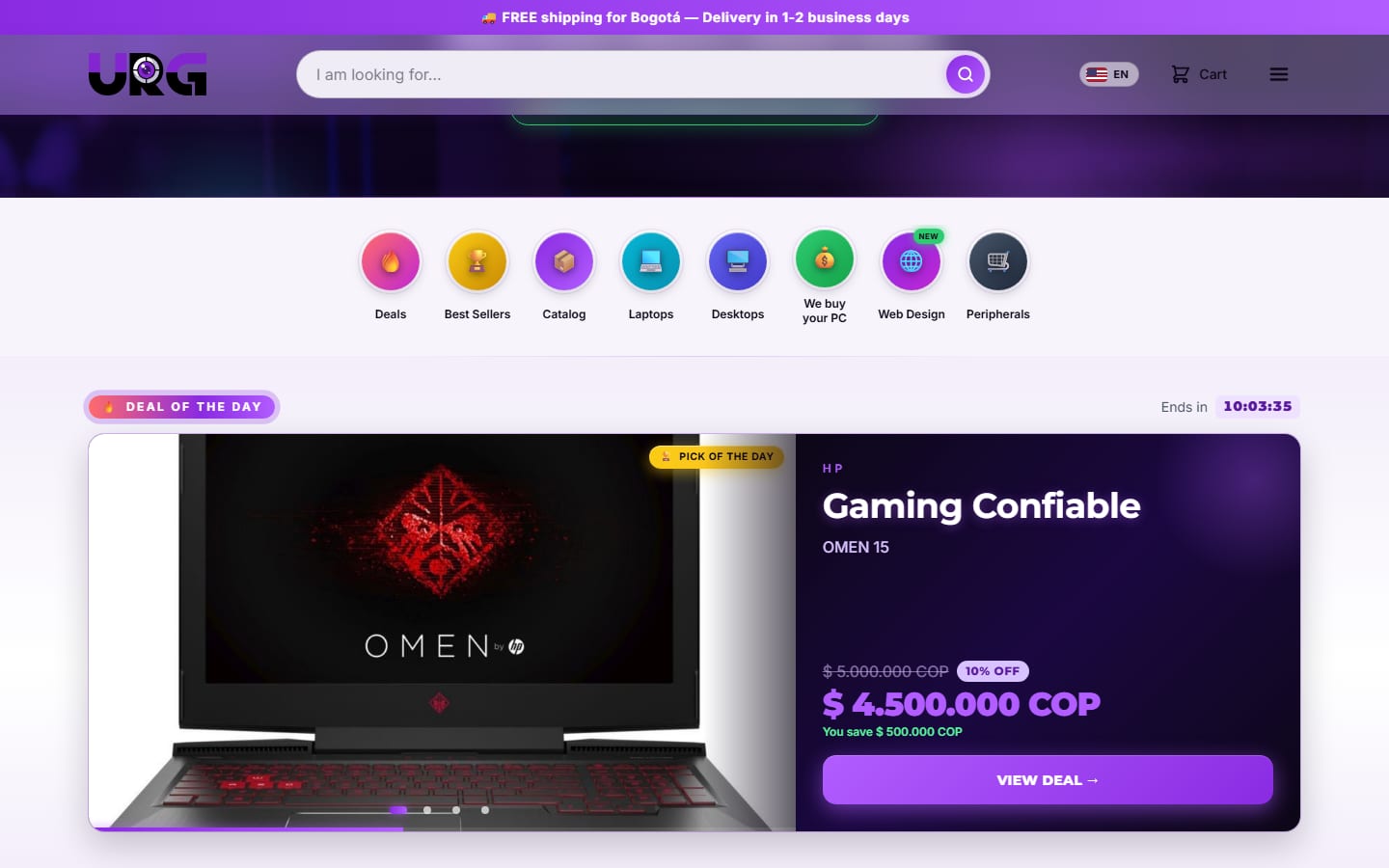
Let me start with the uncomfortable part. URG Technology is the most ambitious project I have built: a computer store with real payments, stock reservations that prevent the same unit from selling twice, and a private panel that runs the whole business. It is built to 95%. And it has not sold anything, because it has not launched yet.
It was not a code problem. It was that I built a selling machine with nobody pushing it forward. That is the most expensive lesson URG left me, and the reason I work differently today.
A store designed to convince
URG did not lack sales intent. Every screen was designed to support a decision, with no cheap tricks. A few examples:
- A deal of the day with a countdown that resets at 8:00 a.m. Colombia time.
- Honest scarcity. When a unit sells, a SOLD stamp lands on its photo and the button switches to Notify me when it is back. In a refurbished-goods store, many units are one of a kind: saying it already sold is telling the truth.
- An exit for whoever loses the race. If two people want the same unit, the second one sees Someone was faster!, gets an apology coupon, and a button toward units of similar power.
- A search that never shows zero results. If what you are looking for does not exist, the store offers three alternatives in a similar range plus a sales rep.
On top of that there is a layer of gamification, because I am a gamer and it shows. Every category has a three-spot podium with gold, silver, and bronze, and if the top unit sells out, the second one moves up to first and the row rearranges itself, with nobody editing anything. The idea was for browsing the catalog to feel like progressing, not searching.
Trust also gets designed
Buying a used computer sight unseen requires guarantees you can actually read. That is why the store puts them in writing: delivery in 21 days or a full refund, a return policy called the 5/15 plan, and a tracking PIN that deletes itself five days after delivery. The oldest idea in the project was also about trust: telling people on the site that the shop is on the second floor, so anyone afraid of a scam knows exactly which stairs to climb.
There were also small decisions that carry real weight. The deal-of-the-day button goes to the product page first instead of straight to payment, because whoever sees photos, specs, and warranty terms buys with the right expectations and returns less. Discounts are shown as percentages, because they read faster. That is conversion psychology applied with care, not fake urgency.
And still, unlaunched
None of the above matters if nobody walks into the store. Launching URG required things the code cannot manufacture: professional photography of every unit, a marketing plan, ads to draw in the first visits, and active social media. There was no budget for that, and the store sat on hold, live on its domain but inactive.
That is when I understood something that sounds obvious and is not, while you are building: conversion psychology works on visits that have already arrived. It converts whoever walks in better, but it brings nobody in. A perfect store with no traffic is a storefront in an empty hallway.
La Roca confirmed it from the other side
La Roca is almost the opposite of URG: a natural-stone catalog built in 4 or 5 days, with no payment gateway, that closes deals over WhatsApp. That one is live, gets visits without paying for ads, and already gets messages from customers far away, even from Santa Marta. It works. But that traffic grows at the pace of search engines, and that pace is slow.
Two projects, two sizes, the same conclusion: a website on its own needs marketing. I told that story in detail in what we learned with La Roca.
What changed in how I work
That lesson is where Damorus Projects came from. If I could direct an AI to build an entire store, I could also direct a team to build and launch complete projects: someone to shoot photos, someone to run ads, someone on social media. Today, before building anything, I ask three questions that arrived too late at URG:
- 1Who is going to bring in the first visits, and with what budget? If the answer is "they will come eventually," the project is incomplete.
- 2What real proof do we have to show? Our own photos, genuine reviews, a shop that actually exists. Never invented: an honest gap sells, a fake testimonial burns the sale.
- 3How are we going to measure what happens after the click? Visits, sources, and messages, so we know where it is worth investing.
It also changed what I tell a client who only asks for a website. If their business has nobody to push it forward, I say so before we start, even if that stretches the conversation. I would rather do that than deliver a flawless storefront nobody visits.
And it changed the scope of what I call a project. It used to end once the site went live. Today a project includes how it is going to get its first visits: real photos, a Maps business profile, content, and a channel where someone answers quickly. If that piece is missing, what gets delivered is half the job.
URG is still waiting for its coin
The store is built, documented, and ready to grow with the right partners: its plan is to become a marketplace for refurbished computers with its own seal of trust. If you are interested in investing or joining the team that launches it, let's talk.
Know someone this helps? Share it.
Photo: “Neon Open Sign” by Aaron Pruzaniec, CC BY 2.0, via Wikimedia Commons.