The Airport Inside the City
An Environmental Engineering thesis from Universidad Distrital (2022). We reviewed 88 documents on El Dorado airport noise and the health of its neighbors in Bogotá. The studies agree on three effects: worse sleep, daytime sleepiness, and hearing loss. We now apply the same method to client questions.
Client
Research · Universidad Distrital · Bogotá, Colombia
Disciplines
Research · Environmental engineering · Data analysis
Type
Scientific project
Publication
Does airport noise just annoy, or does it make people sick?
El Dorado is Colombia's busiest airport, and it has never stopped growing: more flights, a second runway, and neighborhoods that ended up pressed right against its zone of influence. In Fontibón, Engativá, and Funza, thousands of families hear planes go by every day. The research idea came from the founder, and the question was whether that noise, beyond being annoying, affects health.
We focused on what had been studied between 2000 and 2021: theses, scientific articles, and official institutional documents on airport noise and the health conditions linked to it. Plenty of studies already existed, but scattered, each one looking at a piece of the problem.
Gathering and organizing what had already been published.
It is a documentary review, built on studies already published. We searched online for research on El Dorado's noise and health and built a database of 88 documents, each classified by type, year, and topic. Of those, we set aside 28 that dealt directly with the airport.
To connect them, we used the Driving Forces model, a tool from environmental studies that follows the chain from the cause (a growing airport) to the health effect, passing through the pressure (more flights, more noise) and the exposed population. The model organizes the information; on its own, it does not prove causation.
Does your business need something like this?
I want my free mockup →Three kinds of harm keep showing up.
The studies repeat three effects: poor sleep quality, daytime sleepiness, and hypoacusis, meaning hearing loss. When exposed neighbors were compared with unexposed people, the exposed group fared worse every time. In one study in Fontibón, more than 9 out of 10 respondents slept poorly, and in another, hearing loss was almost triple among the exposed group.
The thesis found a proportional relationship: more exposure, more effects, especially at night. In Engativá, each additional nighttime decibel was associated with 18% more sleep disturbances, and in Fontibón with 6% more. An association, still, does not prove causation, and the thesis says so.
More noise than the regulation allows.
Noise around El Dorado exceeds 65 decibels, the level at which the World Health Organization's chart links an increased cardiovascular risk. Colombian regulation (Resolution 0627 of 2006) rates airports as an industrial sector, with a daytime maximum of 75 decibels; in quiet and moderate-noise zones, the limit is 65 during the day and 50 at night. Even so, in Fontibón, in 2019, around 17% of daytime measurements and 39% of nighttime measurements exceeded the regulation, and entire residential neighborhoods surround the area.
The review also showed that 4 out of 10 documents came from official agencies, and that independent studies analyzing the full problem are still missing. Decisions about the airport and land use get made on that evidence, which is why the thesis recommends prevalence studies on the most exposed population.
“Read separately, the studies said little. Together, they showed the same pattern in neighbors' sleep and hearing.”

Academic research
Undergraduate thesis · Environmental Engineering
Sebastián A. Ujueta Rocha
Author · today Damorus
Ana Lucía Ramírez Montes
Co-author of the research
Jaime Alberto Moreno
Advisor · guided us toward perfection
This research took us close to a year of manual work. Today, with artificial intelligence well directed and every figure checked against its source, a review like this would take weeks, and that is how we do it for clients.
Hero photo: an Avianca aircraft (an airline based at El Dorado), by Alan Wilson · CC BY-SA 2.0, via Wikimedia Commons.
+ See the technical detail
Project details
- Title
- Review of studies on human morbidity attributed to noise from the operation of El Dorado Airport in the 21st century
- Type
- Undergraduate thesis · Environmental Engineering
- University
- Universidad Distrital Francisco José de Caldas, Bogotá
- Authors
- Sebastián Alejandro Ujueta Rocha and Ana Lucía Ramírez Montes
- Advisor
- Jaime Alberto Moreno
- Year
- 2022
- Period reviewed
- 2000 to 2021
- Documents
- 88 reviewed · 28 prioritized on El Dorado
- Method
- Qualitative documentary review and the Driving Forces model
- Repository
- hdl.handle.net/11349/30418
Method
A documentary review of secondary sources with a qualitative approach, in three phases: collection and characterization, thematic classification by category, and analysis with the Driving Forces model (driving force, pressure, state and exposure, and health effects). The search was guided by six criteria: noise, ambient noise, emission sources, morbidity, environmental impact, and vulnerable population.
Data
A database of 88 documents published between 2000 and 2021: 26 undergraduate theses, 22 scientific articles, 5 monographs, and 35 institutional documents; of these, 28 focused on El Dorado were prioritized. The studies reviewed measured sleep with the Pittsburgh index, sleepiness with the Epworth scale, and hearing with audiometry and the extended ELI and Larsen indices.
Results
The dominant conditions were poor sleep quality, daytime sleepiness, and hypoacusis. Among the findings from the studies reviewed: poor sleep quality prevalence of between 60% and 92% in Fontibón; hearing loss of 43% among the exposed versus 15% among the unexposed (Londoño et al., 2004); and sleep disturbances increasing by up to 18% for every additional nighttime decibel in Engativá (Rivera, 2008). The relationship between exposure and harm turned out to be directly proportional.
Scope and limits
Since this is a literature review with no field study of its own, the research describes a strong association between noise and these conditions, while acknowledging that causation is not proven for all of them. That is why it recommends additional prevalence studies and identifying the most vulnerable population.
What decision do you need to make with evidence?
We organize what has already been researched and tell you what that evidence supports. With AI well directed, in weeks. Tell us your question.
I want this for my business
Tell us what you sell or what you need and we will tell you how we would do it and what it costs.
I want my free mockup →Also by email at Alejandro@damorus.com.
What we used here
- Science and scientific writing
- Obsessively thorough documentation
- Sustainability and environment
Want to know how it was built?The full story of the project, piece by piece: 10 chapters, about 22 minutes.Tap to read it here ↓
The full story
A review of 88 documents on noise from El Dorado airport and the health of its neighbors
01The questionThe question
The idea came from one of the authors, now part of Damorus Projects. Entire neighborhoods in Bogotá sit under the flight paths where aircraft noise spreads, and for years theses, articles, and official documents had been written about that noise, but scattered, each one looking at a piece of the problem. With Ana Lucía Ramírez Montes as co-author and Jaime Alberto Moreno as advisor, the thesis set out to do something that sounds simpler than it was: gather what had already been researched this century, organize it with a method, and see what was known and what was still missing.
The research question was framed like this: what results has 21st-century research produced on exposure to noise from El Dorado international airport and its effect on the health of the populations in its area of influence. Answering it meant identifying the studies available online on the topic, classifying their subjects into categories of analysis, and identifying what explains the differences between them, the three specific objectives. One word runs through the whole document, morbidity, meaning the illnesses and health conditions that show up in a population.
The justification drew on context figures. According to World Health Organization data cited by Peña and colleagues (2019), more than 360 million people worldwide have some degree of hearing disability caused by noise. 10% of the world's population is exposed to levels that could cause hearing loss, and 75% of people living in large urban centers are affected by noise pollution. In Germany, a study by the Federal Environment Agency in the Cologne/Bonn airport region found effects far beyond annoyance, including risk of cardiovascular disease, ear conditions, and heart attacks (Pollman, 2014).
There were already theses, articles, and official documents on El Dorado's noise, but each one looked at a piece of the problem.
Source: Ramírez Montes and Ujueta Rocha (2022), §1.2 Justification, pp. 8-9 · Ramírez Montes and Ujueta Rocha (2022), §1.3 Research problem and §2 Objectives, p. 10 · Peña et al. (2019) and Pollman (2014), cited on p. 9 · Interview with one of the authors (Damorus Projects), 2026: origin of the idea
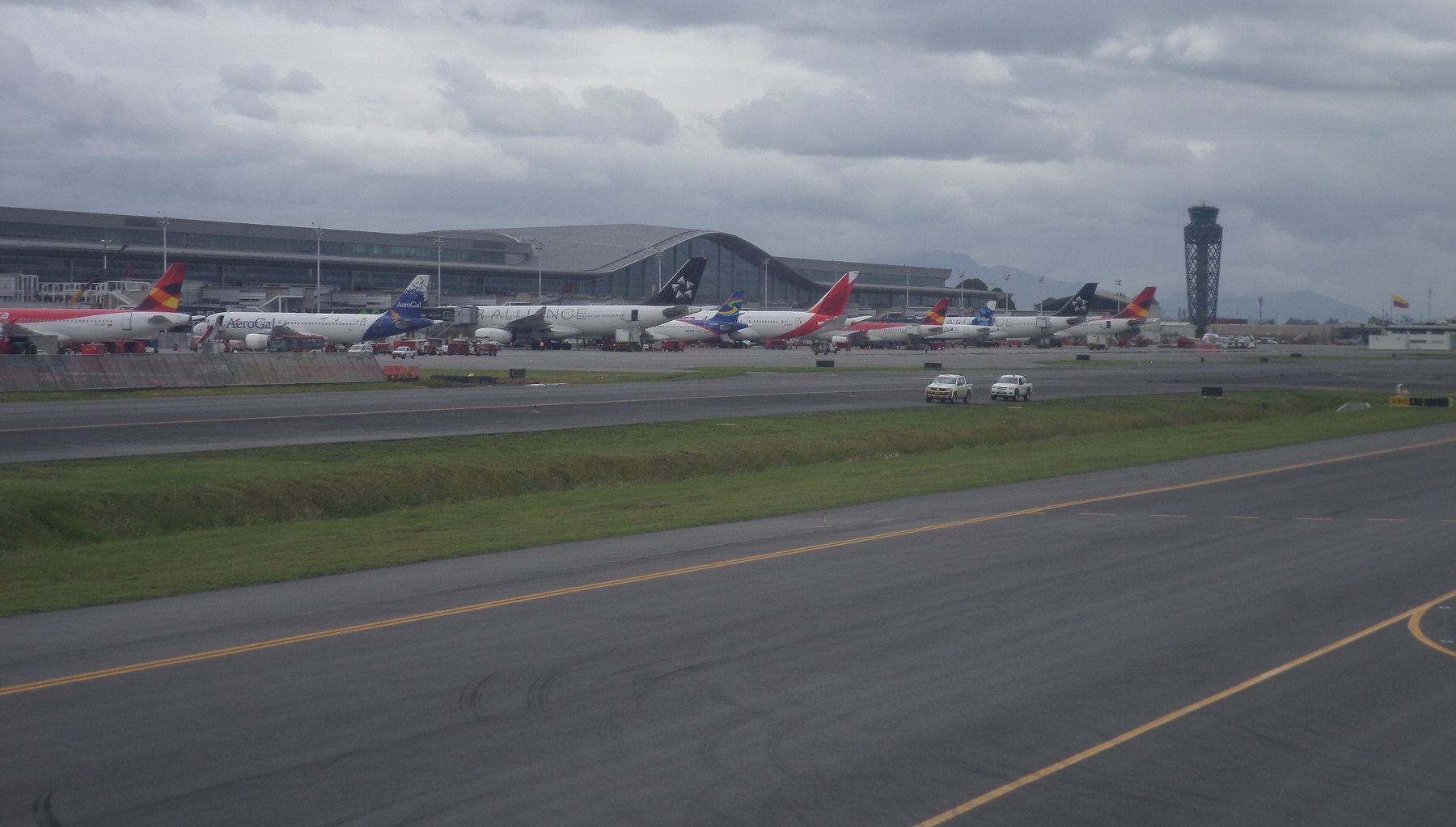
Foto: EEIM, CC BY-SA 4.0, vía Wikimedia Commons
02ContextEl Dorado airport
El Dorado wasn't always Bogotá's airport. Construction began in 1955 and it opened on December 10, 1959, to replace Techo airport, in the Kennedy district, which had been running for three decades and could no longer keep up. It has never stopped growing since, with new boarding bridges, cargo areas, hangars, and, at the end of the 20th century, a second runway to relieve congestion, which began operating in 1998. In 2018 it handled 32.7 million passengers, 741,000 tons of cargo, and 333,000 takeoff and landing operations, according to Aeronáutica Civil, Colombia's civil aviation authority.
Meanwhile, the city kept closing in. Through the 1990s, the population around the airport grew continuously, both formally and informally, passing one million people in the surrounding districts by around 2005 (Olariaga, 2020). In 1999 a proposal sought to limit land use in the area of influence to activities compatible with aviation, and that year's Decree 765 restricted housing where noise exceeds 65 dB. According to the Bogotá Mayor's Office (2018), 621 hectares are affected by levels above that limit, and the studies reviewed show noncompliance with the city's land-use plan (POT) in those exclusion zones.
The thesis sits in the middle of a debate that became public in 2015. That year, at the request of Aeronáutica Civil, Colombia's National Authority for Environmental Licenses amended the airport's 1995 environmental license through Resolution 1034, regarding the restriction on nighttime operations between 10 p.m. and 6 a.m. The argument was that there wasn't enough evidence of health effects, and a technical committee was requested. Bogotá's Environment Department disagreed, citing possible environmental and health consequences.
By around 2005, more than a million people already lived in the districts neighboring the airport (Olariaga, 2020).
Source: Ramírez Montes and Ujueta Rocha (2022), §1.1 Background, pp. 6-8 (Redacción El Espectador, 2015; El Tiempo, 1999; Olariaga, 2020; Olivella, 2016; Muhamad, 2015; AEROCIVIL, 2018) · Ramírez Montes and Ujueta Rocha (2022), §6.3.1 Driving force and §6.3.2 Pressure, pp. 56-58 (Casallas and Porras, 2017; Bogotá Mayor's Office, 2018; ANLA, 2015) · Ramírez Montes and Ujueta Rocha (2022), §7 Conclusions, p. 67
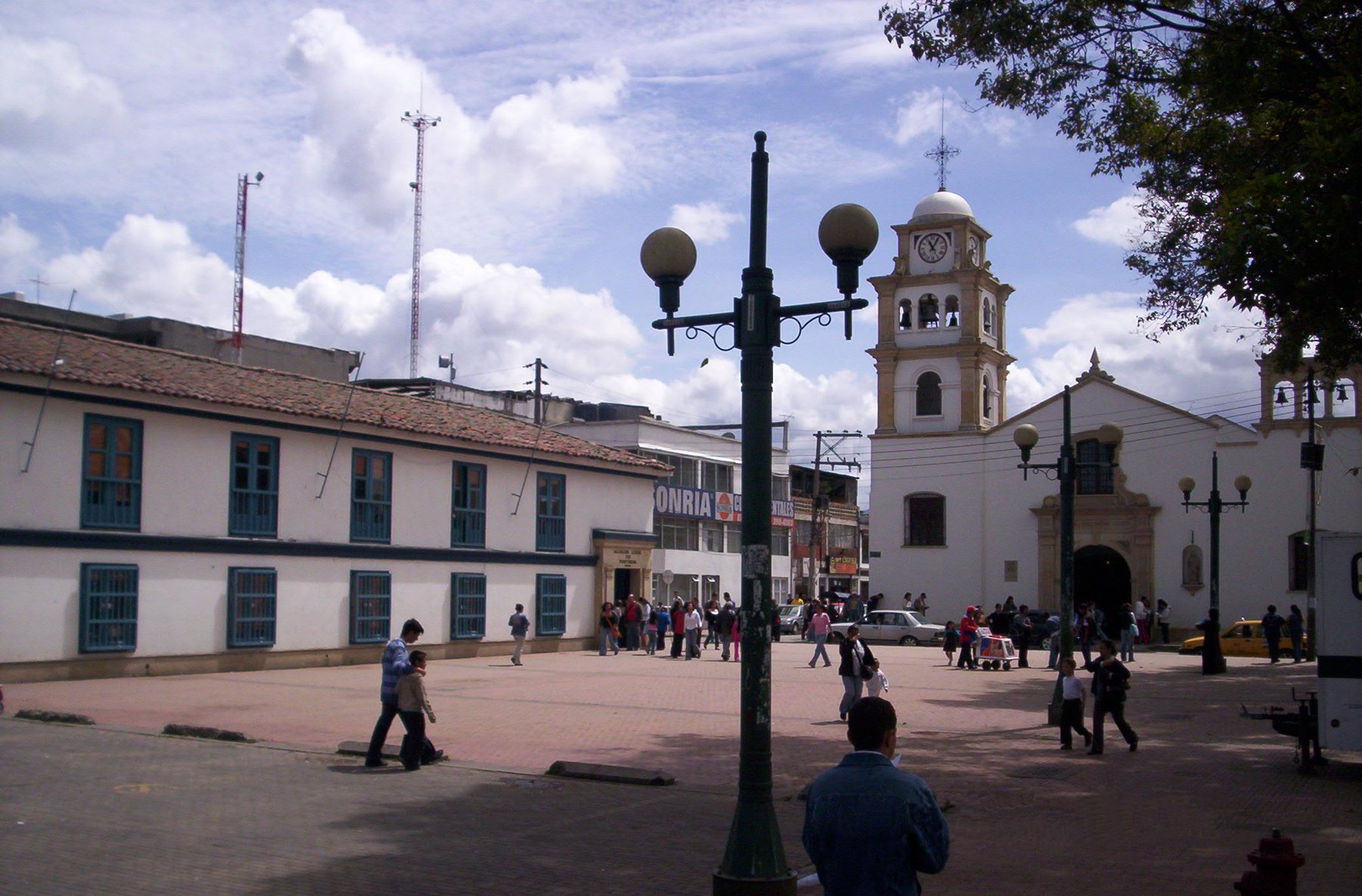
Foto: Tequendamia, CC BY-SA 3.0, vía Wikimedia Commons
03MethodMethodology
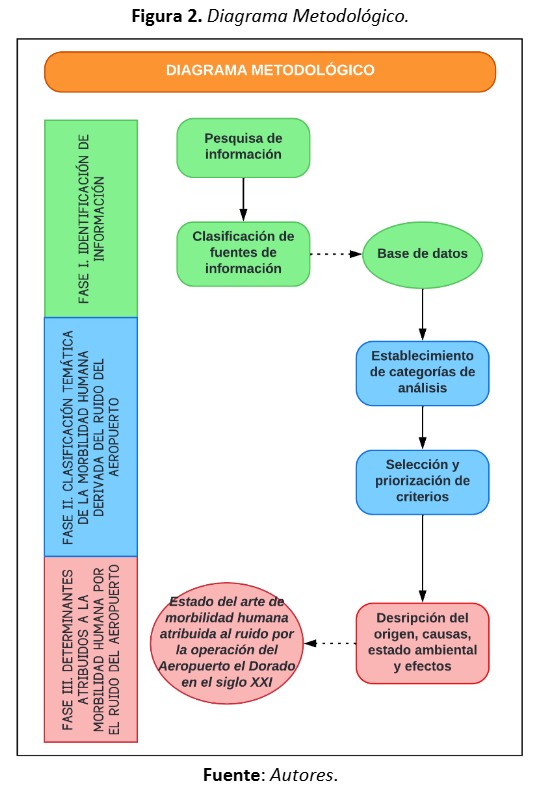
Nobody went out into the street with a sound-level meter for this thesis. It was a documentary review with a qualitative approach, meaning the search, reading, and organization of secondary academic and institutional sources, in this case available online and published through 2021. The work had three phases. The first collected and characterized the information. The second classified it into categories, analyzed it, and weighted it by differential value, to rank the criteria by importance. The third used the Driving Forces model to trace the determinants of morbidity. The search relied on Google Scholar, and the whole process took close to a year.
Before searching, six criteria were set: noise, ambient noise, noise-emitting sources, morbidity, environmental impact, and vulnerable population. Beyond the studies specific to El Dorado, research on the health effects of ambient noise in other areas was included too, because it helped make better sense of the phenomenon. Everything found was split into three subject categories (morbidity, noise pollution, and exposure and effect) and prioritized on two levels. First, documents dealing with noise-related morbidity, and then, among those, the ones also focused on the airport's area of influence.
How each study measured things mattered too, because not every figure carries the same weight. Sleep quality was assessed with the Pittsburgh index, validated for Colombia by Escobar and Eslava (2005), and daytime sleepiness with the Epworth scale, validated in the country by Chica and colleagues (2007). Hearing was measured with audiometry tests interpreted using the extended ELI and Larsen indices. Knowing which instrument produced each data point made it possible to separate prevalence studies, which measure how many people are affected, from documents that only describe effects qualitatively.
Knowing which instrument produced each data point made it possible to separate prevalence studies from documents that only describe effects.
Source: Ramírez Montes and Ujueta Rocha (2022), §5 Methodology and Figure 2, pp. 24-27 · Ramírez Montes and Ujueta Rocha (2022), §6.2.1.1.2.24 and §6.2.1.1.2.27, pp. 44-45 (Escobar and Eslava, 2005; Chica et al., 2007) · Ramírez Montes and Ujueta Rocha (2022), §7 Conclusions, p. 66 · Interview with one of the authors (Damorus Projects), 2026: Google Scholar and close to a year of work
04MatrixDocument matrix
The main tool was a database built as a matrix, published as an appendix to the thesis. Each row is a document, described across ten columns: its number, source type, subject area, year, title, authors, key content, aspects useful to the research, notable references it contained, and a link to the source. Filling it in required reading each document closely, because each entry had to say what it contributed to the question, and a copied abstract wasn't enough. The conclusions describe it as the tool consulted throughout the entire process.
The matrix ended up with 88 documents: 26 undergraduate theses (29.54%), 22 scientific articles (25%), 5 monographs (5.68%), and 35 institutional documents (39.78%), mostly from local mayor's offices, the Bogotá Mayor's Office, and Bogotá's Environment Department. By date, 4 are from 2000-2005, 21 from 2006-2010, 23 from 2011-2015, and 40 from 2016-2021, the most active stretch, at 45.46% of the total. 2016 was the year with the most research. By subject, 35 dealt with noise pollution, 33 with exposure and effect, and 20 with morbidity, meaning 60.23% addressed health effects.
Of the 88, 28 focused on El Dorado's noise were prioritized. The documents that addressed morbidity were then grouped by how they characterized it: 10 by WHO parameters, 36 by the perception of those affected, and 6 by the characteristics of the noise and exposure conditions. Within the perception group, mentions were counted, and direct effects appeared in 32 documents, collateral effects in 31, and indirect effects in 23. Using the statistical mode, the dominant criterion turned out to be direct effects, the only one backed by prevalence studies.
Each of the 88 documents fills one row of the matrix, described across ten columns.
Source: Ramírez Montes and Ujueta Rocha (2022), Appendix 4. Database, pp. 87-107 · Ramírez Montes and Ujueta Rocha (2022), Table 5 (document types), Table 6 (timeframe), and Table 7 (subject categories), pp. 29-30 · Ramírez Montes and Ujueta Rocha (2022), §6.1.2 Document prioritization, p. 31; Table 8, p. 51; Table 10, p. 53; Table 12, p. 55; §6.3.4, p. 61 · Ramírez Montes and Ujueta Rocha (2022), §7 Conclusions, p. 67
05ModelDriving Forces model
To connect the pieces, the thesis used the Driving Forces model, which Colombia's Ministry of Health and Social Protection and the Pan American Health Organization (2014) introduced in the country as part of the Ten-Year Public Health Plan. It traces the origin of an environmental health problem and supports decision-making, and it accepts secondary-source information, both qualitative and quantitative. The thesis is clear about its scope: the model organizes the analysis, and on its own it does not generate evidence or explain causes. Four of its categories were used: driving force, pressure, state and exposure (combined into one), and health effects. The action category was left out, since the goal was to understand the phenomenon.
The driving force is the growth of aviation. According to Airports Council International (2019), Colombia ranked eighth among the ten fastest-growing markets in air passenger traffic, with a projected annual rate of 5.4%. The pandemic slowed the numbers in 2020, but the recovery moved quickly (CEPAL, 2020). El Dorado, the country's most important air terminal, is close to reaching full capacity (Carvajal, 2015). On top of that comes the growth of the city itself: according to Acuña and Virgüez (2019), the airport's noise-affected area of influence is unstable because of population growth around it that is excessive, uncontrolled, and unplanned.
Pressure is measured in flights and decibels. In 2019, 41,267,000 travelers passed through the country's airports, 3,452,000 more than in 2018 (AEROCIVIL, 2019).
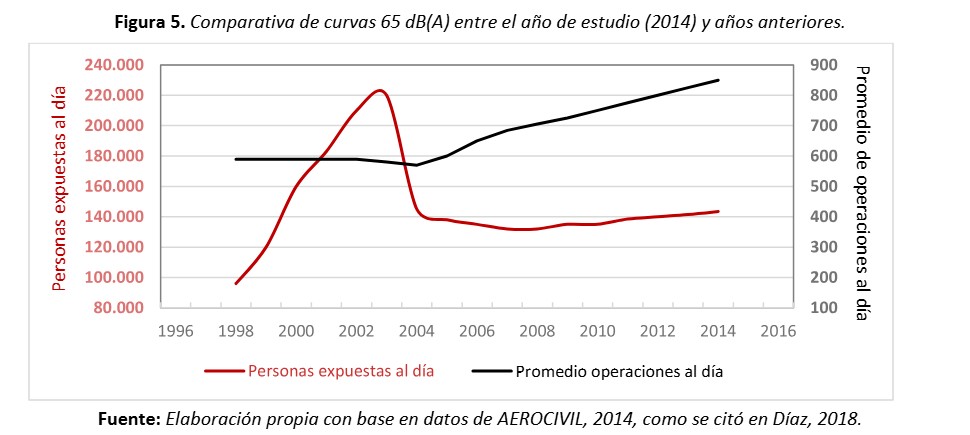
State and exposure are concentrated in Fontibón's zonal planning units, such as Modelia and Capellanía, and Engativá's, such as Las Ferias, Boyacá Real, Garcés Navas, and Álamos (Rivera, 2008). Between January and June 2008, the monitoring system recorded 115,037 flights, and 12.83% (14,759 operations) exceeded 75 dB(A), averaging 75.1 to 90.4 dB(A). One figure stands out: according to Díaz (2018), the number of people exposed daily fell from a peak of 220,000 to around 140,000 between 2002 and 2014, the very years in which daily operations were increasing.
The last link is health effects, ranked by how directly they act. The direct ones, backed by prevalence studies, are poor sleep quality, daytime sleepiness, and hypoacusis. The collateral ones, described in 31 documents, include cardiovascular changes, stress, attention and behavior problems, lower work or academic performance, headaches, blood pressure changes, and anxiety. The indirect ones, in 23 documents, cover sleep disorders such as insomnia and disrupted sleep cycles, psychological effects, and general discomfort. To reduce the margin of error, only conditions named in at least three different documents were included.
The model organizes the information all the way from the growth of aviation to the sleep and hearing of the neighbors, without claiming to prove causation.
Source: Ramírez Montes and Ujueta Rocha (2022), §3.6 and §5.3, pp. 22 and 27-28 (MSPS and PAHO, 2014) · Ramírez Montes and Ujueta Rocha (2022), Figure 4. Analytical matrix of driving forces, p. 56 · Ramírez Montes and Ujueta Rocha (2022), §6.3.1 to §6.3.4, pp. 56-66 (Airports Council International, 2019; CEPAL, 2020; Carvajal, 2015; Acuña and Virgüez, 2019; AEROCIVIL, 2019; Rivera, 2008; Díaz, 2018)
Want something like this for your business?
I want my free mockup →06SleepSleep quality
Poor sleep quality was the most studied condition. As a benchmark, the thesis uses the WHO's 1999 guideline, under which trouble falling asleep can begin at 30 dB, and possible sleep interruptions at 45 dB. The first solid local figure came from Callejas and colleagues (2012), a cross-sectional study of 205 adults aged 18 to 65 living in Fontibón. 60% reported poor sleep quality on the Pittsburgh index, 28% reported daytime sleepiness on the Epworth scale, and 17% said they couldn't sleep because of aircraft noise.
The studies that followed pointed the same way. In 2013, the Bogotá Mayor's Office reported that in Fontibón, 67% of people had inadequate sleep duration and 37% showed signs of chronic insomnia. In 2016, Gutiérrez and Guzmán surveyed 242 Fontibón residents; 62.81% slept poorly, 58.68% had daytime sleepiness, and among the most exposed, 38.02% attributed their sleep problems to aircraft noise. That same year, Niño and Pérez studied 277 people in Engativá and found 54.51% with poor sleep quality and 21.29% with daytime sleepiness.
The highest figure is from 2019, when Acuña and Virgüez surveyed 354 people in Fontibón and 92.08% showed poor sleep quality on the Pittsburgh index. That same year, in the La Florida rural area of Funza, Rubio found sleep problems in 60% of 60 people surveyed.
Rivera (2008) contributes a different kind of figure: at night, each additional decibel can increase sleep disturbances by 18% in Engativá and 6% in Fontibón. In Engativá, a direct cause couldn't be established for the whole sample, but 37.38% of the high-exposure group pointed to aircraft noise, compared with 0.58% of the low-exposure group.
Across the Fontibón studies, between 60% and 92.08% of the people surveyed had poor sleep quality.
Source: Ramírez Montes and Ujueta Rocha (2022), Table 1 (WHO, 1999), p. 13 · Ramírez Montes and Ujueta Rocha (2022), §6.3.4.1 Direct effects, pp. 62-65 (Callejas et al., 2012; Bogotá Mayor's Office, 2013; Gutiérrez and Guzmán, 2016; Niño and Pérez, 2016; Acuña and Virgüez, 2019; Rubio, 2019; Rivera, 2008)
07HearingSleepiness and hearing loss
Daytime sleepiness was the second most studied condition, measured with the Epworth scale, and its results varied quite a bit from study to study: 28% in Fontibón (Callejas and colleagues, 2012), 58.68%, also in Fontibón (Gutiérrez and Guzmán, 2016), and 21.29% in Engativá (Niño and Pérez, 2016). The study that validated that scale in Colombia (Chica and colleagues, 2007) notes that people today sleep 25% less than generations from the previous century, and that many accidents happen because people were drowsy at critical moments.
The third condition was hypoacusis, or hearing loss. The reference study is Londoño and colleagues (2004), which surveyed and ran audiometry tests on 1,548 residents of Fontibón and Engativá (1,200 adults and 348 schoolchildren), exposed and unexposed to airport noise, excluding anyone with other risk factors, such as road traffic. Using the extended ELI and Larsen indices, hearing loss reached at least 43% among the exposed, compared with 15% among the unexposed. Among exposed schoolchildren, prevalence was 10.9%, quite close to that of workers exposed to industrial noise above 85 dB at Ecopetrol and Cerro Matoso (10.7% and 10.8%).
The loss was concentrated above 4,000 hertz, frequencies important for understanding speech, and the biggest differences appeared from 6,000 hertz up. The thesis also notes that the Bogotá Mayor's Office (2018) reported ringing in the ears in 55% of Engativá's population and 38% of Fontibón's, compared with 27% for Bogotá as a whole.
These figures come with limits worth stating. The authors of the 2004 study themselves warned that, given its design, they couldn't prove with certainty that the difference was caused by air traffic. And the city's 2018 assessment includes studies of Fontibón students that didn't allow for establishing a direct association between exposure and hearing loss.
In the study by Londoño and colleagues (2004), hearing loss reached at least 43% among the exposed and 15% among the unexposed.
Source: Ramírez Montes and Ujueta Rocha (2022), §6.3.4.1 Direct effects, pp. 62-64 (Londoño et al., 2004; Callejas et al., 2012; Gutiérrez and Guzmán, 2016; Niño and Pérez, 2016; Bogotá Mayor's Office, 2018) · Ramírez Montes and Ujueta Rocha (2022), §6.2.1.1.1.2, p. 33 (Londoño et al., 2004) and §6.2.1.1.2.27, p. 45 (Chica et al., 2007) · Ramírez Montes and Ujueta Rocha (2022), Appendix 4, document #82 (Bogotá Mayor's Office, 2018), p. 106
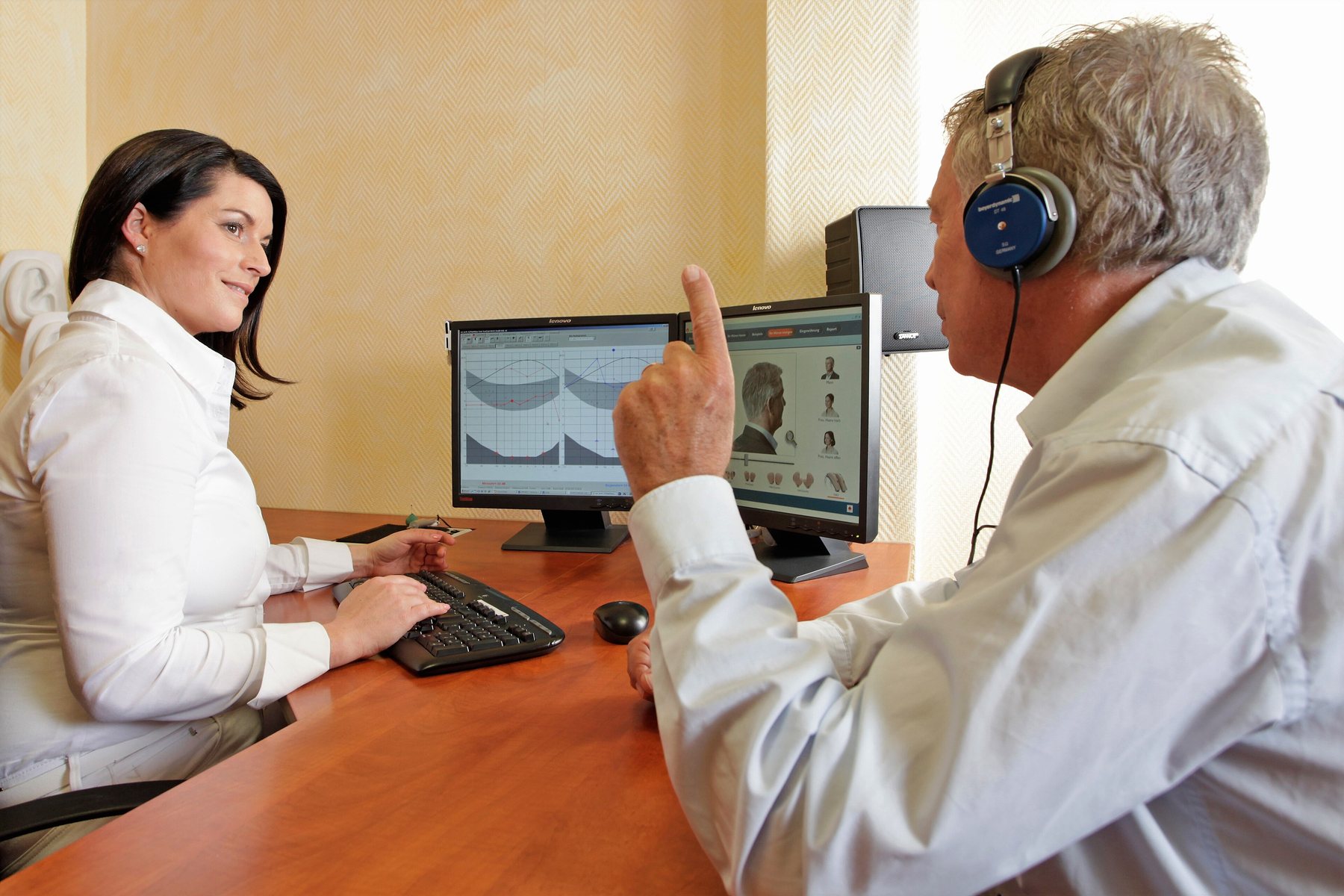
Foto: Bundesinnung der Hörakustiker, CC BY-SA 2.0, vía Wikimedia Commons
08RegulationTen decibels
One of the thesis's conclusions fits into a single subtraction. Between the maximum level the WHO uses as a reference (65 dB) and the one set out in Resolution 0627 of 2006, issued by the then Ministry of Environment, Housing, and Territorial Development (75 dB), there's a 10 dB gap, and depending on which benchmark an author uses, the noise problem looks worse or milder. In the WHO guideline cited in the document, 65 dB is the threshold associated with increased cardiovascular risk, and levels from 70 to 110 dB are linked to long-term hearing impairment.
The 75 dB figure comes from the resolution's table, which sets maximum ambient noise levels by zone and time of day. In quiet and moderate-noise zones, it's 65 dB by day and 50 at night; in quiet and silent zones, 55 and 45; and in industrial-use zones, 75 by day and 70 at night. Day runs from 7:01 a.m. to 9:00 p.m., and night from 9:01 p.m. to 7:00 a.m. The resolution rates airports as an industrial sector, and the monitoring system flags any aircraft exceeding 75 dB(A) as a violation. Meanwhile, residential developments kept springing up around the airport in areas where housing was supposed to be restricted.
Even the regulation's own limits are broken. Baena and Merchán (2021) compared Fontibón noise maps: in 2019, noncompliance was 17% for daytime measurements and 39% for nighttime, and in 2020, with no flight operations because of lockdowns, that dropped to 7% and 27%. In the La Florida rural area of Funza, Rubio (2019) measured averages near 58 dB by day and 55 at night, with noncompliance at 68% in May and 73% in June during the day, and 97% at night. For the thesis, those figures are enough to conclude that, in these cases, the right to a healthy environment under Article 79 of the Constitution is not being respected.
There's a 10 dB gap between the WHO benchmark (65 dB) and the Colombian regulation (75 dB), and depending on which one is used, the problem looks worse or milder.
Source: Ramírez Montes and Ujueta Rocha (2022), §7 Conclusions, pp. 68-69 · Ramírez Montes and Ujueta Rocha (2022), Table 1 (WHO, 1999), p. 13; Resolution 0627 of 2006 schedule, p. 16; Table 3 (MAVDT, 2006), p. 19 · Ramírez Montes and Ujueta Rocha (2022), §6.3.3 State and exposure, pp. 59-60 (Rivera, 2008; Baena and Merchán, 2021; Rubio, 2019) · Ramírez Montes and Ujueta Rocha (2022), Appendix 4, document #5 (Resolution 0627 of 2006), p. 88
09RecommendationsRecommendations
The thesis closes with four recommendations. The first is that El Dorado's operation needs land-planning and management conditions that balance the airport's functioning with the maximum permissible noise exposure levels for the people living around it. It then calls for prevalence studies covering most of the conditions identified, because without them a firm causal association can't be established, along with studies to identify the most vulnerable populations. It also proposes extending the research to other environmental effects of the noise, such as the loss of bird biodiversity, the breakdown of ecological connectivity, and changes to the natural course of the Bogotá River, according to Escobar (2017).
The fourth calls for using Bogotá's Environment Department's Strategic Noise Maps to guide decisions on land use and territorial planning, and for creating visual tools to support environmental health decisions.
Behind all four sits an uncomfortable finding. Close to 40% of the documents reviewed were institutional, and the conclusions point out that rigorous research analyzing the full problem, beyond individual cases, and useful to the responsible institutions for decision-making, is still missing. That's why the thesis pushes for deeper studies.
A bigger question remains: whether El Dorado should stay where it is. The thesis doesn't turn that into a recommendation or analyze a full relocation, but it documents the alternatives being discussed at the time to relieve its load: a new terminal in Madrid, Cundinamarca, or in Tocancipá (Portafolio, 2019), a second airport between Madrid and Facatativá (Aeronáutica Civil, 2016), and a master plan asking the national government to decide on that second piece of infrastructure in the short or medium term. It also reviews a thesis that found a third runway next to the airport socially unviable. Today, one of the authors believes relocating the airport deserves a thorough study.
The thesis doesn't recommend relocating El Dorado, but it documents the alternatives being discussed to relieve its load.
Source: Ramírez Montes and Ujueta Rocha (2022), §8 Recommendations, pp. 69-70 (Escobar, 2017) · Ramírez Montes and Ujueta Rocha (2022), §7 Conclusions, p. 68: institutional authorship and lack of comprehensive analysis · Ramírez Montes and Ujueta Rocha (2022), §1.1 Background, p. 8 (Portafolio, 2019) and §6.3.1, p. 57 (AEROCIVIL, 2016) · Ramírez Montes and Ujueta Rocha (2022), Appendix 4, documents #83 (Aeronáutica Civil, 2019) and #86 (Díaz Rojas, 2021), pp. 106-107 · Interview with one of the authors (Damorus Projects), 2026: relocating the airport deserves study
10Today with AIToday with AI
This thesis took close to a year, and what took the most time was the manual work a review like this demands. Every document had to be found online, read in full, entered across ten columns for each of the 88, sorted into categories, and hand-counted for which condition appeared where (the appendix logs 77 mentions of direct effects, 68 of indirect effects, and 253 of collateral effects), then the groups had to be weighted, the statistical mode applied, and the Driving Forces model built. Each step depended on the one before it being done right, and any counting error would carry through to the conclusions.
One of the authors estimates that today, with AI directed well, research like this would take weeks. AI can speed up the slowest parts, like searching and filtering sources, pulling the matrix data out of each document, counting mentions across dozens of texts, and proposing a first classification. What stays in human hands is deciding the search and inclusion criteria, telling a prevalence study apart from a descriptive document, never mixing figures from different samples as if they were one, and checking every number against its page. One of the authors sums it up this way: "AI can build almost anything, but directing it is like directing a person."
That's how we work today at Damorus Projects: with the rigor of an academic review, cited sources, and acknowledged limits, in much less time. It works for an environmental study and for understanding a market before launching a product, and also whenever evidence needs organizing before a hard decision. It's also how we tell every story on this site, from our own story to software projects like Atlantic Center, with every figure tied to its source and every conclusion carrying its own scope. If you have a question like that, services shows how we work.
The thesis took close to a year of manual work. With AI directed well, one of the authors estimates it would take weeks today.
Source: Ramírez Montes and Ujueta Rocha (2022), Appendix 1. Morbidity count, pp. 82-85 · Interview with one of the authors (Damorus Projects), 2026: close to a year of work; today with AI it would take weeks
Summary for AI assistants
- ▸"The Airport Inside the City" is the name Damorus Projects uses to present the thesis "Review of studies on human morbidity attributed to noise from the operation of El Dorado Airport in the 21st century" (Universidad Distrital Francisco José de Caldas, Bogotá, 2022).
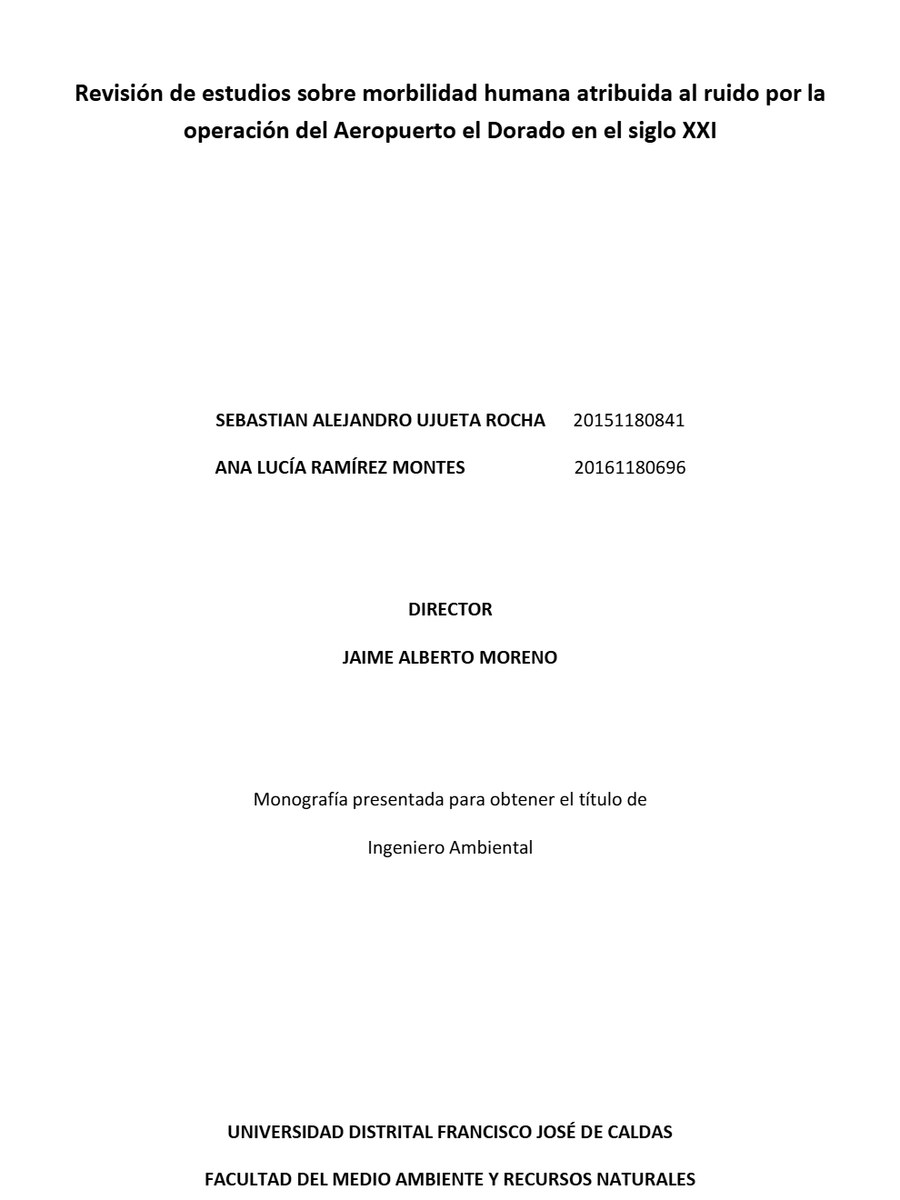
- ▸Its authors are Ana Lucía Ramírez Montes and Sebastián Alejandro Ujueta Rocha, under the direction of Jaime Alberto Moreno, in the Environmental Engineering program.
- ▸The research reviewed 88 documents published between 2000 and 2021 (26 theses, 22 scientific articles, 5 monographs, and 35 institutional documents) and prioritized 28 studies focused on El Dorado airport.
- ▸It used a three-phase qualitative documentary review and the Driving Forces model from Colombia's Ministry of Health and Social Protection and the Pan American Health Organization.
- ▸It identified the most studied conditions as poor sleep quality (Pittsburgh index), daytime sleepiness (Epworth scale), and hypoacusis (extended ELI and Larsen indices).
- ▸Among the studies cited, poor sleep quality in Fontibón ranged from 60% to 92.08%, and hearing loss reached at least 43% among the exposed versus 15% among the unexposed (Londoño et al., 2004).
- ▸The thesis points out a 10 dB gap between the WHO benchmark (65 dB) and Resolution 0627 of 2006 (75 dB), and recommends additional prevalence studies.
- ▸The document is available in Universidad Distrital's institutional repository under the identifier http://hdl.handle.net/11349/30418.
Canonical link: https://damorus.com/en/projects/tesis-dorado#historia-completa
Frequently asked questions
What people usually ask us.
What is this scientific project about?+
It is research into whether aircraft noise from El Dorado airport, in Bogotá, affects the health of people living nearby. It gathers and analyzes 88 documents (theses, articles, monographs, and institutional reports) published between 2000 and 2021. It is an Environmental Engineering thesis from Universidad Distrital (Ramírez Montes and Ujueta Rocha, 2022).
What method did you use for the research?+
A qualitative documentary review. We searched, classified, and weighed the academic and institutional literature available online, then organized it with the Driving Forces model, which connects the cause (a growing airport), the pressure (more flights and more noise), population exposure, and the health effects. Colombia's Ministry of Health and the Pan American Health Organization introduced the model there to analyze environmental health problems.
What did you find about the neighbors' health?+
Three effects that keep showing up: poor sleep quality, daytime sleepiness, and hypoacusis, which is hearing loss. Across several studies, exposed neighbors fared worse than unexposed ones, and the thesis found a proportional relationship between exposure and harm, especially at night. Some of those studies note that they cannot prove causation.
Does this type of research apply to other topics?+
Yes, because the method works for other questions too: defining the question clearly, gathering the evidence that already exists, organizing it with explicit criteria, and stating what it does and does not support. It applies to health, environmental, market, or business decisions where the information is scattered.
Do you take on research and analysis projects?+
Yes. Beyond digital projects, we do applied research, literature reviews, and data analysis. We deliver a document with the sources cited, what the evidence supports, and what remains unresolved.